graduation money from an aunt who loved me in secret, and the kind of humiliation that burns so deep it becomes fuel. I worked mornings in a coffee shop where my shoes smelled like espresso grounds by noon. I worked evenings at a hotel front desk where wealthy strangers talked over me as if I were furniture. In between, I studied business administration and taught myself to stop waiting for someone to rescue me.
Yes, the visible things changed over time. The braces came off. My skin cleared. I traded glasses for contacts. I learned how to dress in a way that felt less like camouflage and more like choice. But the real transformation had nothing to do with appearance.
I stopped believing that being chosen by my family meant I had value.
That was the beginning of everything.
By twenty-eight, I was consulting for small regional firms that had brilliant products and terrible financial habits. By thirty, I had launched Aurelian Advisory, a financial strategy company built on one principle: most collapse begins long before anyone admits there is a problem. I had spent my life around people who cared more about the optics of success than the architecture of it. I knew exactly how dangerous that was.
The firm grew slowly, then all at once. A struggling logistics company became a turnaround success. A regional manufacturer avoided bankruptcy after we restructured a disastrous expansion. Then a publication listed Aurelian among the most promising consulting firms in the state. Then came bigger clients, private investment groups, and, eventually, a Fuentes subsidiary exploring a major development project.
I never contacted my family.
But success has a way of traveling back to the people who once hoped you would stay small.
Three weeks before Sarah’s wedding, an invitation arrived at my office in a thick cream envelope edged in gold. Sarah Martínez and Michael Fuentes. Formal reception to follow at the Grand Velásquez Hotel. I almost dropped it straight into the trash.
Then I saw the name.
Michael’s father, Eduardo Fuentes, was not merely wealthy. He was the kind of man local newspapers called visionary and rivals called dangerous when the cameras were off. He had recently begun circling a real estate and infrastructure expansion that overlapped with advisory work my firm had touched. He was also exactly the type of man my father had always wanted near the family business.
That was when I understood the invitation.
Not love. Not regret. Timing.
I was no longer the ugly graduate.
I was an asset.
I spent two nights deciding whether to go. In the end, I chose clarity over comfort. I wanted them to see me. Not because I needed their approval, but because I wanted them to look directly at the life they had forfeited any right to narrate.
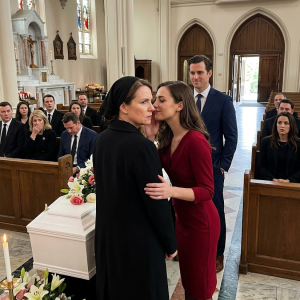
So I wore red.
Not because it was dramatic, though it was. Not because it would make an entrance, though it did. I wore red because for years my mother insisted I should stick to quiet colors that did not draw attention to me. She used to say bold shades belonged to girls who could carry them. That night, I carried red like a verdict.
The ceremony itself was immaculate. White orchids. Candlelight. Strings. Tailored tuxedos. Sarah looked beautiful, and I