hands.
Franklin’s tone was almost painfully calm. “No one is contesting the existence of the will,” he said. “We are reviewing evidence of fiduciary misconduct, forged accountings, and concealed guardianship information.”
My mother turned to me. “What exactly have you been told?”
I looked at her then, truly looked at her, and realized something startling.
She was not worried about hurting me.
She was worried about losing control of the story.
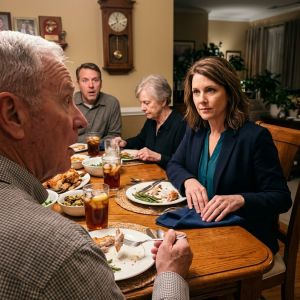
Samuel did not answer her. He walked to the long dining table by the window, set the recorder down on the wood, and pressed play.
Static crackled once.
Then my father’s voice filled the room.
It was younger, smoother, confident in the way men sound when they believe everyone important is on their side.
“If Daniel’s girl is fed and clothed, that is care enough,” the recording said. “Lyanna is the one with promise, and I will not apologize for putting money where it matters.”
The room went absolutely still.
On the recording, Samuel’s voice asked, “You understand those funds are restricted to Julia’s benefit?”
My father laughed.
Then my mother answered, clear as glass. “She should be grateful we took her at all. Without us, she would have grown up with strangers. We are family. Family reallocates when necessary.”
There was a rustle of paper, then my grandfather’s voice for the first time, harder than I had ever heard it in life. “What you are describing is theft.”
My father replied, “Call it what you like. Lyanna deserves the best. Julie is ordinary. Practical. She does not need the same investment.”
My mother added, in a tone that would have sounded almost bored to anyone who did not know it was carving up a child’s future, “And honestly, Theodore, the girl never notices much. She is just happy to be included.”
The recording continued. It documented my grandfather warning them that falsified guardianship reports were crimes. It documented my father insisting that he could “clean up” any irregularities before anyone outside the family asked questions. It documented my mother worrying only about appearances. At one point, my father said, “By the time Julie is grown, there will be nothing left for her to question.”
When Samuel stopped the recorder, the silence that followed felt heavier than shouting.
Lyanna was crying.
Not loudly. Just tears slipping down a face that seemed to have lost all its practiced confidence. She looked at my parents as if seeing them for the first time. “Is that real?” she whispered.
Neither of them answered.
That silence answered better than words.
My mother recovered first, as she always did. “You don’t understand the context,” she said sharply. “We were under pressure. Your uncle’s estate was complicated. Money was moved temporarily. Families make decisions together.”
“Did I make them with you?” I asked.
She looked at me as if the question were insolent.
My father’s face had gone mottled. “We raised you,” he said, and there it was, the defense he believed canceled every other fact. “Whatever mistakes were made, we gave you a home.”
“With my own money,” I said.
He flinched.
I had never seen that before either.
Franklin opened his folder and began outlining the next steps in a voice stripped of all family softness. The estate would suspend distributions. He would