public image was spotless.
For months she sorted receipts, reconciled grants, and prepared reports.
Then she began noticing entries that repeated across different projects, invoices billed twice, contractors paid before bids existed, and donations that vanished between intake and disbursement.
At first she assumed incompetence.
Then she found patterns too consistent to be mistakes.
Lucía copied pages quietly and asked questions carefully.
The answers grew evasive.
A junior accountant warned her to stop digging.
Varela himself called her into his office one afternoon and thanked her for being thorough in a tone that sounded more like a warning than praise.
She went home pale that evening and told Ramiro something was wrong.
He urged her to go straight to the authorities.
She wanted stronger proof first.
That decision almost got her family erased.
According to the evidence in the box, Lucía began documenting everything.
She photographed transfers.
She recorded conversations.
She arranged to meet an investigative journalist, but canceled after realizing she was being followed.
She also prepared for the possibility that the police could not be trusted.
That was the part that saved Ramiro.
She hid duplicates away from the house and stitched the locker key and note into Salomé’s favorite doll, choosing the one object no intruder would think to search thoroughly and no child would willingly give up.
On the night Lucía died, she called Ramiro at the garage and told him to come home immediately.
He remembered every second of that drive because, for five years, it had been the road that led him into a nightmare.
When he arrived, the front door was ajar.
A lamp was broken in the hallway.
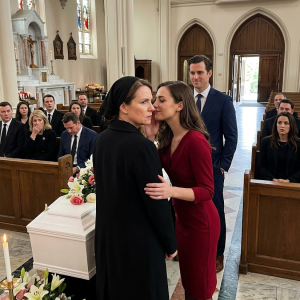
He found Lucía on the living room floor, bleeding and barely conscious.
The revolver on the floor was his, taken from the locked drawer in their bedroom.
He grabbed it in shock, then dropped to his knees and tried to lift Lucía.
That explained both the fingerprints and the blood.
What he had never been able to prove was what happened in the seconds after.
He heard a car door slam outside.
He ran to the porch and caught only the tail end of a dark sedan turning the corner.
The neighbor across the street saw him in the doorway covered in blood.
By the time police arrived, the story had already been reduced to something simple enough for headlines: husband, wife, argument, gun.
Detective Paredes made sure it stayed that way.
He ignored the signs of forced entry because there were none; Lucía had opened the door to someone she knew.
He dismissed Ramiro’s insistence about the car.
He never meaningfully pursued the foundation angle.
He coached the neighbor’s uncertainty into certainty.
During trial, he presented himself as a methodical detective and Ramiro as a man inventing shadows to escape a deserved sentence.
Salomé had been three then, hiding in the hallway linen closet where Lucía shoved her when the confrontation turned dangerous.
She remembered almost nothing in words.
Just fragments.
A polished shoe.
A hand with a silver horse-head ring.
A low whistle used twice before the front door closed.
Trauma buried the memory deeper each year.
And yet children sometimes keep the truth in strange forms.
After Lucía’s death, Salomé clung to the rag doll day and night.
Her grandmother assumed