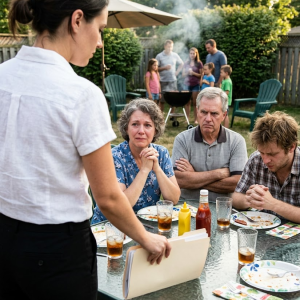
a few feet away, hat in hand.
He was not a man given to apologies, but he made one anyway.
He told Ramiro the system had almost killed an innocent man on his watch.
Ramiro looked at him for a long moment and said the only reason he was standing there was because Méndez had listened when it mattered.
It was not forgiveness for everything the prison represented, but it was something honest, and Méndez accepted it with the gravity it deserved.
The criminal trial against Varela and Paredes concluded eight months later.
The cassette was authenticated.
Lucía’s handwriting was authenticated.
The financial fraud trail was overwhelming.
Most devastating of all was a second digital file recovered from the flash drive: a scanned statement Lucía had drafted for federal investigators but never got to deliver, laying out names, dates, shell companies, and the specific threat Varela made against Ramiro.
Faced with the evidence, Paredes eventually turned on Varela in exchange for a reduced sentence.
He admitted the frame-up had been arranged the night Lucía refused to surrender her copies.
Varela was convicted.
So was Paredes.
The public loved to call it a miracle because miracles are easier to accept than institutional failure.
But the truth was smaller and harder.
A woman had prepared for the possibility of her own death.
A child had protected what adults overlooked.
And one prison director had chosen, in the last possible hour, not to look away.
On the first Sunday after Ramiro regained custody of Salomé, they visited Lucía’s grave.
Salomé brought Rosita, newly repaired but with the old ribbon preserved in a small envelope.
Ramiro knelt beside the headstone and told Lucía he was sorry he had not been able to save her.
Then he thanked her for saving him anyway.
Salomé placed her hand over the engraved name and said she had kept the doll safe like Mama asked, even before she understood why.
Neither of them cried the way they had in prison.
Grief felt different in open air.
A year later, Ramiro was back working as a mechanic, this time in a shop owned by a friend who had never believed the murder story.
Salomé went to school in the same neighborhood where Lucía had once balanced ledgers at the kitchen table.
She still kept Rosita on a shelf beside her bed, no longer as a hiding place for evidence but as proof that memory can survive even when justice does not want it to.
Some nights, Ramiro still woke before dawn with the old panic in his chest, thinking he was back in the cell waiting for the locks to turn.
Then he would hear soft footsteps in the hallway and Salomé asking whether he was awake, and the sound would bring him all the way back to the life he almost lost.
The whisper that stopped his execution was only a few words long.
But it carried a dead woman’s courage, a child’s faith, and the truth powerful men failed to bury.
That evening, after homework and dishes and the ordinary small noises of a home repaired, Ramiro tucked Salomé into bed.
She asked him whether the bad men could ever hurt them again.
He told her no.
This time, it was the truth.
He turned off the