The question seemed to split the wedding in half.
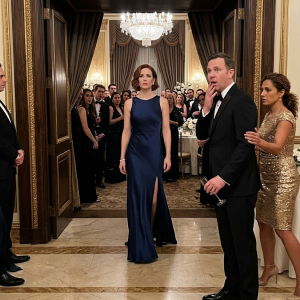
One moment there was music rolling beneath the chandeliers, waiters gliding between tables, and guests raising phones to capture the bride’s entrance.
In the next, the room was so quiet that the clink of a fallen fork sounded like glass breaking.
At the foot of the flower-covered staircase stood a thin boy in oversized secondhand clothes, a cheap plastic plate overturned near his shoes, staring up at the bride as if the world had finally shown him a face he had spent years inventing in the dark.
Valeria Montaño stopped so abruptly that the satin hem of her gown swayed around her ankles.
The smile that had been carefully resting on her mouth vanished.
She had noticed the child only because he had stepped forward when everyone else stepped back.
But then she followed his gaze to her wrist, and her body turned cold.
On her right arm, just below the lace cuff, was the red braided bracelet she had worn every day for nearly eleven years.
It was faded now, softened by time, but the pattern was unmistakable.
The boy was trembling.
Not the light tremor of shyness, but the hard shaking of someone whose whole body understood the danger of hope.
His eyes moved from her face to her bracelet and back again.
They were not her eyes, Valeria thought wildly, but something in them struck her with the force of memory anyway.
Behind her, Andrés Herrera, the groom, came down one step and placed a steady hand at the small of her back.
He felt her go rigid beneath the silk and instantly knew this was not some childish interruption.
Months earlier, during one of the long conversations that make or break a marriage before it begins, Valeria had told Andrés the secret she had spent years saying only in locked rooms.
At seventeen she had given birth to a son.
Her father had hidden the pregnancy, her family had controlled every hour around the delivery, and within days the baby had been taken from her.
She had been told he died during a storm before he ever reached the shelter where they claimed he was being sent.
Andrés had not flinched from the story.
He had only taken her hand, touched the red bracelet, and said that some grief never stops looking for its name.
Now that name stood in front of them wearing cracked shoes and hunger on his face.
Valeria took one step forward.
Her bouquet slipped lower in her fingers.
She could barely make her voice work.
She asked him softly what his name was.
The boy swallowed hard before answering.
Elías, he said.
My name is Elías.
The syllables hit her chest like stones dropped into deep water.
Her knees weakened.
She had not heard that name spoken aloud by a child in ten years.
She crouched despite the tightness of the dress and held out her hand.
Elías hesitated, then extended his wrist.
There it was: another red braided bracelet, old, worn thin, nearly the twin of the one she wore.
Valeria let out a sound that was half breath, half sob.
When she had been heavily pregnant, trapped in a room by a father more concerned with reputation than mercy, she