in Elías’s shoulders loosened for the first time that night.
When it came time for his vows, Andrés turned first to Valeria.
He promised that he would never ask her to pretend the lost years had not happened or that pain should disappear on command just because joy had arrived.
He promised that her past would never be treated as a stain in his home.
Then he faced Elías.
He said that he knew a child could not be asked to trust on the strength of one afternoon, so he would not make grand demands.
He would make promises instead.
He promised that Elías would not beg outside another door for food.
He promised that no illness of a loved one would ever again be met with helplessness if he could stand in the gap.
He promised to earn the right, day by day, to be someone the boy did not fear.
Valeria could barely speak through her tears when her turn came.
She told Elías that she had loved him before she saw his face, while he was still only movement beneath her heart.
She confessed that she had failed to break free when it mattered most and that she would grieve that weakness for the rest of her life.
But she also promised that the rest of that life would no longer be lived far from him if he allowed her near.
She said she would not force the word mother onto his tongue before it was ready.
She would simply stay, and stay, and stay until he believed it.
Don Bernardo bowed his head and wept into folded hands.
The rings were placed on their fingers by Elías himself.
His hands shook so hard that Andrés had to gently steady them.
When the officiant finally pronounced them married, the cheer that went up from patients, nurses, guests, and staff traveled down the corridor like sunlight.
Some clapped.
Some cried openly.
One elderly woman in a wheelchair crossed herself and said it was the first wedding she had attended that felt like prayer.
Instead of a grand kiss for the cameras, Andrés kissed Valeria softly, then pressed his forehead to Elías’s hair.
It was enough.
More than enough.
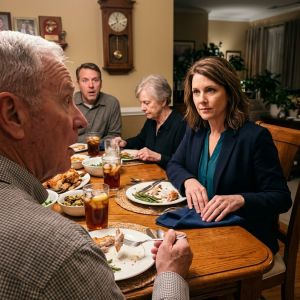
The food from the hacienda did not go back to the reception hall.
At Andrés’s suggestion, it was served first to patients’ families waiting through the night and to the hospital staff who had missed dinner.
Wedding guests in designer shoes passed plates to exhausted relatives in plastic chairs.
Boxes of pastries went to the pediatric wing.
A line cook from the hacienda showed the hospital kitchen how to reheat the mole without drying it out.
Elías watched the strange reversal with wide eyes.
For once, rich people were not protecting abundance from him.
They were handing it out.
Near midnight, after the last of the formalities had dissolved into embraces and paperwork, a pulmonologist examined Don Bernardo again.
The old man was gravely ill, but not beyond help.
He needed stronger medication, nutrition, rest, and ongoing monitoring he could never have afforded.
Andrés signed the financial guarantees before the doctor finished explaining them.
Don Bernardo protested weakly, embarrassed by the cost.
Andrés answered that a man who had spent eight years keeping a child alive did not owe humility