month to visit Bernardo’s specialists and listened seriously when the boy explained which medicine bottle was which.
Trust grew there, in repetition.
The first time Elías fell asleep in the car and his head tipped against Andrés’s arm, the man stayed parked in the driveway ten extra minutes rather than wake him.
On the anniversary of the storm, the four of them drove to the bridge near Canal de la Viga.
Traffic snarled nearby, vendors shouted, and the city continued with its indifference, but for them the place had become sacred.
Valeria brought white flowers.
Teresa came too, at Elías’s request, standing a little apart.
Don Bernardo leaned on a cane and pointed to the spot where he had first seen the basin caught in reeds.
He said he remembered thinking the crying was too angry to belong to a child planning to die.
Elías laughed at that.
Together they placed the flowers in the water and watched them drift away.
No speeches were grand.
They did not need to be.
Valeria then pulled three new red braided bracelets from her bag.
She had made them herself over several evenings, clumsy at first because her hands were no longer those of a trapped teenager.
She tied one around Elías’s wrist, one around her own, and one around Andrés’s.
A fourth, already faded by weather, remained on Don Bernardo’s arm because Elías had secretly woven it for him during tutoring breaks.
The old man pretended not to be pleased, which fooled nobody.
There at the canal, where one life had nearly been erased, the family remade its symbol not as a wound but as a bond everyone could see.
The real turning point came quietly, without witnesses.
It was a Tuesday night.
Rain tapped the windows of the new house.
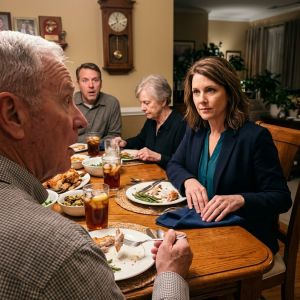
Homework was spread across the dining table, and Bernardo was grumbling about overwatered tomato plants.
Valeria stood at the stove stirring soup.
Elías looked up from his notebook and, without thinking about how enormous the word was, asked, Mom, can you help me with this sentence? The spoon slipped from Valeria’s hand into the pot.
She turned slowly.
Elías froze, startled by his own mouth.
Then Valeria smiled with tears already in her eyes and answered as if the word had lived there forever.
Of course, she said.
Show me.
From that night on, nothing was perfect, but it was real.
There were still bad dreams.
There were still court dates and hard conversations and sudden grief that arrived without warning.
Yet there was also breakfast before school, medicine taken on time, birthdays planned in advance instead of survived by chance, and a front door that opened only to welcome.
Don Bernardo sat in the garden most afternoons with a blanket over his knees and a satisfied look he tried to disguise as criticism.
Teresa kept her promises and learned to accept the pace at which trust was granted.
Andrés and Valeria built their marriage around the fact that love had already asked them for more than romance and had found them willing.
By the following year, visitors to the house would sometimes see a framed scrap of paper in the hallway, protected behind glass despite its stains and torn corners.
Beside it hung a family photograph taken in ordinary clothes