the memory of that moment to be clean.
Then I told them the truth with no tremor in my voice.
They had not made me strong.
They had made me lonely.
They had not taught me discipline.
They had taught me that help came with humiliation.
I said I would not spend the rest of my life acting grateful for surviving what they had chosen to normalize.
After that, I left, and I did not look back through the glass door.
Lily and I were different.
We did not become sisters in one dramatic embrace.
We became two women trying, awkwardly, to speak without the old script.
She took a teaching job at a community arts center.
She apologized once without asking for absolution, which I respected more than tears.
Months later we had coffee and spoke about ordinary things for nearly an hour before either of us mentioned our parents.
It felt small and enormous at the same time.
I do not know what our relationship will be in every future season, but it is real now, and real is better than pretty.
By the end of that year, I bought a modest white house with a deep porch and a study full of afternoon light.
It was the kind of place I used to slow down and admire from the bus, the kind of home I thought belonged to people who had been chosen early and repeatedly.
On the day I got the keys, my grandfather stood beside me on the empty living room floor and laughed when he heard the echo.
He said my grandmother would have approved of a house with good windows and no unnecessary nonsense.
Then he cried, which I had only seen him do twice before in my life.
I hugged him and let him cry.
One of the last things we did together before Christmas was set up a small emergency grant through a local women’s center in my grandmother Eleanor’s name.
It helps with rent gaps, car repairs, utility shutoff notices, the kind of ordinary emergencies that can tip a careful life into disaster.
I did it because I know exactly how expensive seven hundred dollars can feel when you are alone and ashamed.
I did it because there are women who do not need a lecture about resilience; they need one safe month to breathe.
Sometimes people hear the outline of my story and think the ending is the money.
It is not.
The money mattered.
It gave me options, safety, time, treatment, and a house where no one can tell me I am asking for too much by simply existing in it.
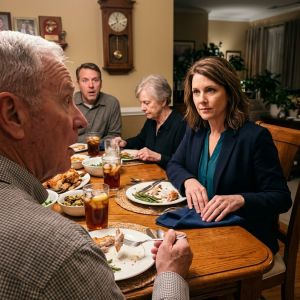
But the real ending came much earlier, at a dining room table, when the family version of me finally broke apart.
I was not difficult for needing help.
I was not noble for needing less.
I was not better because I could endure more neglect with a quieter face.
I was a daughter whose inheritance was taken, a young woman who was lied to, and a person who deserved the truth long before she had to fight for it in court.
On my twenty-ninth birthday, I baked my own cake and invited only three people to dinner: my grandfather, Lily, and the friend who had sat with