of us,” I said.
“But only one of us stole my dress and wore it to my father’s funeral.”
Her face changed then.
For the first time all morning, she looked exactly twenty-eight.
Small.
Frightened.
No practiced angle left to hide behind.
She yanked her hand from Grant’s and tried to step away from him, as if the room had not watched her lace her fingers through his ten minutes earlier.
Ellen’s expression sharpened.
“Corporate counsel will be contacting you before end of day, Ms.
Thornton.
I strongly advise you not to delete anything.”
Becca went white.
Grant said my name again, but now it sounded like a plea, not a command.
I did not answer.
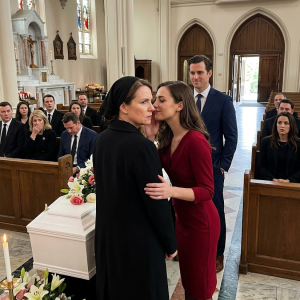
Security escorted them out through the side aisle.
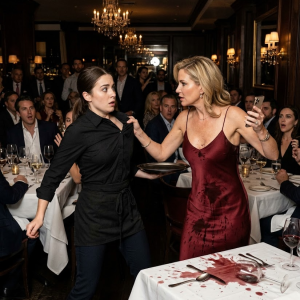
Becca stumbled once on the hem of the midnight-blue dress.
I will tell you honestly that I took no pride in that moment.
Only relief.
When the side door shut behind them, the cathedral remained suspended in a strange, echoing quiet.
Then the priest looked at me with extraordinary gentleness and asked, “Would you like a moment?”
I thought about it.
Then I shook my head.
“No,” I said.
“My father hated lateness.
Let’s bury him properly.”
And so we did.
I set the codicil down, unfolded the second page from the envelope, and read the letter my father had written to me alone.
It was shorter than I expected.
Natalie,
If you are hearing this in public, then my timing was worse than I hoped and your husband was worse than I feared.
I am sorry for both.
I did not tell you sooner because I wanted certainty before I added pain to your plate, and because you were trying to help me die with dignity, which I noticed even when morphine made me slow.
You are not foolish for loving someone.
You are only foolish if you keep loving what evidence has already disproved.
I knew about the dress.
No decent man gives away a gift he never bought, especially one chosen by a dying father.
Stand up straight.
The room will remember who you are.
Love,
Dad
I do not remember much of the homily after that.
I remember the warmth of the paper in my hands.
I remember Martin taking the pages from me at the right moment.
I remember saying the words of my father’s eulogy with a voice that somehow kept working.
I spoke about his discipline and his terrible jokes.
About how he never entered a negotiation without first deciding what he could live without.
About the way he had loved my mother for thirty years and never once made devotion look like sacrifice.
I spoke about the notes he used to leave inside gifts, books, briefcases, kitchen drawers.
Little commands disguised as affection.
Bring a coat.
Don’t trust a man with soft handshakes.
Call me when you land.
Remember who you are before you speak.
By the time we walked him out beneath the bell tower, my humiliation had been outpaced by something steadier.
Clarity.
The reception afterward was held in the parish hall.
There were silver coffee urns, small sandwiches nobody wanted, and the strange social choreography that follows a public collapse.
People approached in careful waves.
Some offered condolences first and questions second.
Others skipped the