this looks.”
I actually laughed.
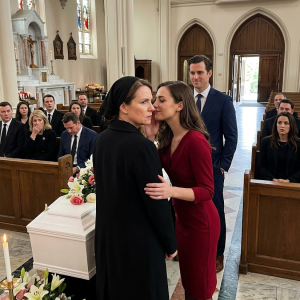
“You mean the affair, the fraud, or the fact that you gave my father’s birthday gift to your girlfriend and brought her to his funeral? Which part would you like me to misunderstand?”
He ran both hands through his hair.
“The money was temporary.
I was going to put it back.
Becca got out of hand.
I didn’t know she’d say those things in church.”
That was the sentence that finished whatever remained of my marriage.
Not I’m sorry.
Not I was wrong.
Becca got out of hand.
As if the real problem had been optics.
“You’re done here,” I said.
“Take what your attorney says you’re entitled to and be grateful my father believed in paperwork more than revenge.”
He stared at me.
“You’re really ending fifteen years like this?”
I looked past him to the front door, where the new locksmith was testing the deadbolt.
“No,” I said.
“You ended fifteen years like this.
I’m just the one closing the door.”
He never came inside again.
Within a week, the board ratified his removal unanimously.
The auditors confirmed the fraudulent transfers.
Bennett Strategic referred the file to prosecutors.
Faced with criminal exposure, Becca cooperated.
She turned over email chains, burner-account logins, lease documents, and messages that made it painfully clear Grant had planned to use my father’s death as cover for a financial and personal transition he believed I would be too broken to challenge.
He had underestimated two people.
My father.
And me.
The criminal case took months.
The divorce took less than a year.
Grant pleaded to fraud-related charges before trial and lost the reputation he had spent his adult life constructing.
He did not go to prison for as long as some people hoped, but he went long enough to emerge into a life that no longer had my name, my house, or my family attached to it.
Becca left the city before sentencing.
I heard she moved back to Phoenix and started using her middle name professionally.
I felt no need to follow the details.
Some endings do not require witnesses.
As for the company, Ellen stayed close, Martin stayed sharper than ever, and I learned faster than anyone expected.
I had grown up around boardrooms, but I had never wanted to sit at the head of one.
After my father died, wanting stopped mattering.
Responsibility remained.
So I took my seat.
We sold off what needed selling, stabilized what needed stabilizing, and rebuilt the marketing division from the floor up.
We created a scholarship fund in my father’s name for first-generation business students, because he had never forgotten what it meant to be the least powerful person in the room and still decide to master it.
Nearly a year after the funeral, on the night of the scholarship dinner, I opened my closet and looked at the dress.
Martin had arranged for it to be returned after evidence processing.
It came back in a preservation box, professionally cleaned, the crystals intact.
For months I could not touch it.
Then one evening I lifted it out, held the silk against my palms, and realized it no longer smelled like the funeral.
Or like betrayal.
It smelled like cedar and time.
So I wore it.
When I entered the ballroom