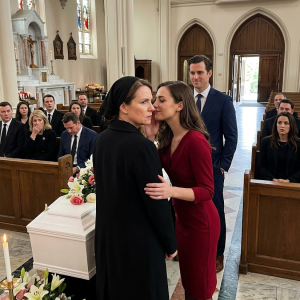
questions entirely and simply squeezed my hand with the solemnity of witnesses.
Martin did not let me stand alone for more than ten seconds.
When the room thinned enough to talk, he led me into the priest’s small library and closed the door.
Then he handed me the full investigative binder.
My father had hired Charles Dunn six weeks before he died.
It started, Martin explained, with invoices.
My father still reviewed large expenditures even from hospice because work gave him structure when his body stopped cooperating.
He noticed repeated marketing charges approved by Grant for campaigns no one could quite explain.
He also noticed that Becca Thornton’s name surfaced around those approvals with suspicious frequency.
Then one afternoon, while Grant took a call in the hospice hallway, my father heard him say, “After the funeral it won’t matter.”
That sentence had been enough.
The investigator found the affair within days.
The money trail took longer, but it was worse than simple infidelity.
Grant had approved nearly half a million dollars in fraudulent consulting payments to an LLC Becca created.
He used company funds to rent an apartment downtown, billed travel that had never happened, and diverted vendor retainers to cover personal debt I had never known existed.
The house entry was the part that made my hands shake.
Three weeks earlier, while I was at hospice and then meeting with palliative care staff, Grant had texted our part-time house manager that he needed a guest access code reset for a delivery.
Forty minutes later Becca entered my home.
The investigator photographed her leaving with a garment bag.
My dress.
Such a small theft in comparison to the money.
And somehow the most intimate.
Martin slid a second folder toward me.
It contained copies of the corporate resolutions my father had prepared before he died.
He had moved his shares into a trust with instructions that voting control transfer immediately to me upon his death.
He had removed Grant as successor executor.
He had amended governance documents to bar any officer under active fraud review from accessing company systems.
My father, even from hospice, had built me a firewall.
I sat in that little library and cried harder than I had cried in the cathedral.
Not because of Grant.
Because even while dying, my father had spent his remaining strength trying to make sure I would not be left defenseless.
The next forty-eight hours moved with surgical precision.
Corporate counsel locked Grant out of Bennett systems before sunset.
Ellen called an emergency board meeting for the next morning.
The firm’s outside auditors were brought in.
Becca did not come to work.
Grant sent me nineteen texts, then four voicemails, then two emails with subject lines that moved from Please let me explain to We can fix this to Don’t destroy everything over one mistake.
One mistake.
I filed for divorce before noon the next day.
When Grant finally cornered me, it was in the driveway of our house, while the locksmith was changing every code.
He looked wrecked.
No tie, no polish, no boardroom charm left.
For one wild second I saw the man I had once believed was my safest place, and the loss of that illusion hurt almost more than the betrayal.
“Natalie,” he said, “I know how