until the family court made the appointment permanent.
Álvaro stood up so fast the pew creaked.
‘That’s ridiculous,’ he snapped.
‘I’m her husband.’
Javier went on as if he had not spoken.
Lucía’s life insurance, maternity benefits, savings, and the proceeds from the pending sale of a small lot of land left by her father were all directed into the same trust.
Not a cent was to be placed under Álvaro’s control.
Not now.
Not ever.
‘You can’t do that,’ Álvaro said, louder now.
‘You can’t cut out a spouse without cause.’
Javier finally looked at him again.
‘There is cause.’
I will never forget the silence after those three words.
Javier turned to the next page and read Lucía’s explanation in her own language, preserved inside the legal document because she had insisted it remain there.
She wrote that her husband had subjected her to emotional cruelty, repeated infidelity, financial pressure, and intimidation during her pregnancy.
She wrote that he had attempted to isolate her from her family.
She wrote that he had pressured her to sign documents while she was medicated, exhausted, or frightened.
She wrote that if anything happened to her before she could leave the marriage formally, her mother was to protect her child from him.
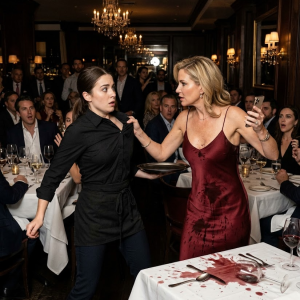
The woman in red shifted in her seat for the first time.
Javier read on.
Lucía had not prepared only a will.
She had prepared an evidentiary packet.
It was labeled Appendix C and, according to her instructions, was to be opened if Álvaro contested the will, interrupted the reading, or appeared publicly with the woman she named as Renata Valdés.
The church erupted.
The woman in red went white.
Álvaro cursed under his breath.
My sister made a noise halfway between a gasp and a sob.
Even the priest looked startled enough to forget the solemn mask he had worn all morning.
Javier placed a thick folder on the altar.
‘Miss Valdés,’ he said, ‘Lucía knew your name, your workplace, and your relationship to her husband.
She also knew you had access to several transactions executed from accounts that did not belong to you.’
Renata’s confidence vanished so suddenly it was almost frightening.
She looked at Álvaro, but he was staring at Javier with naked panic for the first time.
Inside the folder were copies of hotel invoices, transfer receipts, text messages, email printouts, and photographs.
Lucía had gathered them over months.
Some she had discovered herself.
Some had been retrieved later by Javier and a forensic accountant after Lucía quietly authorized an audit of her business records.
There were weekend reservations billed to a company card Álvaro had no right to use.
There were transfers from Lucía’s design studio into an account linked to Renata’s consulting firm, a firm that did not exist except on paper.
There were screenshots of messages in which Álvaro promised that once Lucía signed over broader authority on the business, ‘we’ll never have to hide again.’
A low sound moved through the pews like wind through dry leaves.
One of Javier’s assistants, whom I had not noticed at the back of the church, began handing copies of selected pages to the two notary witnesses, to the parish secretary, and to my brother.
Everything was being documented.
Everything had already been documented before Álvaro