room was ready.
I told her I did not care what the neighbors said, or what the church said, or what his family said.
I told her she could come home with nothing and I would still call it enough.
She would listen with her eyes full of tears she refused to let fall, and then she would squeeze my hand and say, ‘Just a little longer, Mom.
I need to believe the baby will change everything.’
The baby had changed everything.
Lucía went into labor early on a rainy Tuesday night.
She called Álvaro seventeen times.
He did not answer.
It was their elderly neighbor, Mrs.
Alvarez, who drove her to St.
Catherine’s Hospital while Lucía gripped the dashboard and tried not to cry.
By the time Álvaro arrived the next morning, our granddaughter had been born, and Lucía had already lost too much blood.
She died eight hours later.
When Álvaro finally appeared at the hospital, he cried beautifully.
So beautifully that nurses put sympathetic hands on his shoulders.
He held the baby for exactly three minutes.
Then he asked about insurance forms.
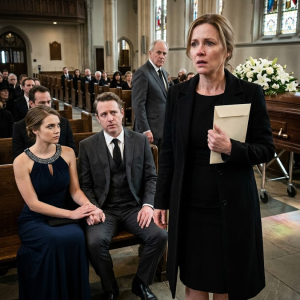
At the funeral, he dropped into the front pew with the woman in red beside him and crossed his legs as though he were settling in for a performance.
When the priest spoke of eternal love, I heard Álvaro let out the faintest laugh.
That was when a man rose from the side aisle.
Javier Morales was Lucía’s attorney.
I had met him only once in the hospital corridor, where he had introduced himself quietly and told me Lucía had left instructions that needed to be honored after the funeral.
He was in his fifties, silver-haired, with the steady face of a man who had long ago learned not to waste emotion in public.
Now he approached the altar carrying a sealed envelope.
He waited until the murmurs softened.
Then he said, in a voice so calm it forced the whole church to listen, ‘Before the burial, I am required to carry out an express legal instruction left by Lucía Gómez.
Her will is to be read here, in the presence of witnesses.’
Álvaro gave a short laugh.
‘A will? My wife didn’t have anything I didn’t know about.’
Javier turned toward him.
He did not raise his voice.
He did not need to.
‘That statement, Mr.
Serrano, is one of several reasons this reading must happen publicly.’
The church went still.
Javier broke the seal, unfolded the papers, and began.
The first lines were formal: Lucía’s full name, the date, the certification, the names of the witnesses who had signed with her.
Then he lifted his eyes and said, ‘I will begin by naming the first beneficiary.
María Gómez, mother of the deceased.’
I felt every gaze in the church land on me.
Álvaro straightened.
The woman in red blinked once, quickly, as if she had misheard.
Javier continued reading.
Lucía’s apartment, purchased before her marriage, was mine.
So were the contents of the safety deposit box only I and Javier knew existed.
Her shares in the event-design business she had built from nothing were not to pass to her husband.
Instead, they had already been transferred into an irrevocable trust for her daughter, Eva Lucía Serrano, with me named trustee and primary guardian