questioning immediately after the service.
Renata’s lips parted, but no sound came out.
Álvaro looked at me then, really looked at me, as if seeing me for the first time not as Lucía’s soft-hearted mother, not as a woman he had lied to over coffee and Easter lunches, but as the person his wife had trusted when everything else failed.
His anger searched my face for fear and did not find it.
He tried one last performance.
He spread his hands and spoke in that injured, polished tone I had heard him use on neighbors and nurses and waiters when he needed to appear reasonable.
He said Lucía had been confused, fragile, manipulated by pregnancy, manipulated by me, manipulated by grief.
He said everyone knew how dramatic women could become under stress.
Then Javier read the last personal bequest.
To Álvaro Serrano, my wedding ring, to be returned after lawful inventory, as a reminder that vows broken in private do not disappear simply because others fail to hear them.
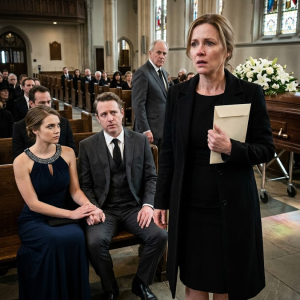
For the first time, the church did not whisper.
It reacted.
Someone near the back said, loudly, ‘Shame on him.’ Another voice followed.
Then another.
It was not chaos.
It was worse for him than chaos.
It was consensus.
Renata stepped away from Álvaro as if the air around him had become dangerous.
He reached toward her instinctively, but she pulled her arm back.
Her face had collapsed into the pale, stunned look of a person realizing she had not been standing beside a winner at all.
She had been standing beside a man whose lies were finally ending in daylight.
The detectives waited with professional patience.
They did not place cuffs on anyone in front of the coffin.
They simply made it clear the choice was gone.
Álvaro tried to protest again.
He said he would sue.
He said Javier was finished.
He said Lucía could not defame him because she was dead.
That last sentence was the one that turned the room against him completely.
Even the priest took a step back.
When the detectives guided Álvaro and Renata toward the side aisle, the clicking of her heels no longer sounded sharp or triumphant.
It sounded small.
Frightened.
Human.
The church doors closed behind them with a final, heavy thud.
Only then did the room become worthy of my daughter.
The priest looked at me before resuming, as if asking permission.
I nodded because there was nothing left to interrupt now.
Lucía had spoken.
Everyone had heard her.
The truth, once given a voice, had taken up more space in the church than Álvaro ever had.
We buried my daughter that afternoon beneath a pale sky.
I stood at the grave holding my granddaughter while damp earth fell in soft sounds onto the coffin.
Eva slept through the entire burial, one tiny fist curled against the blanket.
I remember thinking that the same hands that had signed legal documents to protect her were the hands that had stroked her face for only a few hours.
Grief has a way of breaking your heart twice in the same breath.
After the cemetery emptied, Javier approached me with a smaller envelope.
He said Lucía had asked that I open it only when we were alone.
Inside was a handwritten note, brief