My mother said it like she was telling me she had picked up milk.
“I sold your car for Hannah,” she told me, calm as ever.
“She needed the money more than you needed some flashy toy.
Besides, none of this would have happened if you had not turned your back on your own family.”
For a few seconds, my mind simply refused to understand her.
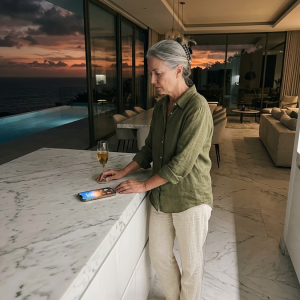
I stood in the kitchen of the Beverly Hills home I had built from nothing, one palm pressed against the cool edge of the marble counter, staring at the sink like it might steady me.
Afternoon sunlight stretched across the oak floors and lit up the handmade tile backsplash I had spent three months choosing.
Outside, my lemon trees moved slightly in the breeze.
Everything in that house carried a memory of work.
The floorboards reminded me of the first year I could finally pay myself a salary.
The stone counters reminded me of the launch weekend when I stayed awake for forty-two hours because our sustainable skincare line sold out faster than we could pack it.
The big kitchen windows reminded me that I had once eaten dinner on the floor of a studio apartment because I could not afford a table.
And in my garage, until that afternoon, had been my obsidian black Mercedes-Benz.
I bought it the year my company crossed seven figures.
Not because I wanted people to stare.
Not because I needed anyone to envy me.
I bought it because I needed one solid, beautiful, impossible thing that proved I had made it out.
Every morning when I saw that car, I remembered who I had been before the brand, before investors, before the articles calling me self-made.
I remembered the girl who packed orders until her back ached and cried quietly in the shower because her mother had called her selfish for missing Hannah’s birthday dinner during launch week.
That car was not just a car.
It was proof that I was no longer trapped.
Now my mother was telling me she had sold it as if she had cleaned out a closet.
“What did you just say?” I asked.
My voice sounded calm, which almost made the moment worse.
Somewhere inside my chest, panic was pounding against my ribs, but my mouth stayed level.
“You heard me,” she said.
“I sold the Mercedes.
Hannah was desperate.
We needed fast cash.”
“You sold my Mercedes?” I repeated.
“My car? From my garage?”
She sighed in that tired, theatrical way she had perfected when I was a child and dared to need an explanation.
“Kate, do not start.
Your sister is drowning.
Fifty thousand dollars is not a small amount of money.
You could have helped her immediately, but no.
You had to punish her.
You had to make a point.”
I closed my eyes.
Hannah’s debt had not come from medical bills.
It had not come from rent, or food, or a terrible accident.
Hannah had burned through money on a boutique fitness franchise she never opened, then credit cards, then an online gambling app she swore was just for fun.
When I found out she owed fifty thousand dollars to a private lender, my mother called me sobbing.
I had offered to pay for a financial advisor,