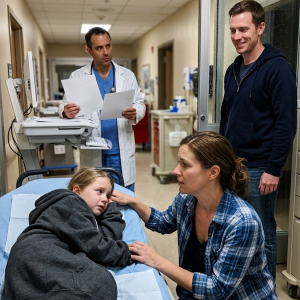
The question landed so gently that for a second Susan almost failed to hear the danger in it.
Dr.
Evans had turned half away, eyes narrowed at the ultrasound screen, her fingers frozen over the keyboard.
It was supposed to be an ordinary post-retirement physical, the kind people scheduled once they finally had time to think about their own bodies.
Instead, with one careful sentence, the doctor made the past open beneath Susan’s feet.
“Susan, I need you to answer me honestly,” Dr.
Evans said.
“What has your intimate life been like over the last eighteen years?”
Susan gave a brittle laugh that was not really a laugh at all.
“Nonexistent,” she said, staring at the floor.
“My husband and I haven’t shared a bed since 2008.” Saying the year out loud still felt like reopening a cut that had never closed.
Dr.
Evans finally looked at her, and there was no judgment there, only a careful kind of concern that made Susan wish there had been judgment instead.
“Then this finding doesn’t line up,” the doctor said.
She turned the monitor slightly and tapped a pale, irregular crescent on the image.
“There is significant calcified scarring on the uterine wall.
This kind of scar usually follows an invasive procedure.
A surgery, a curettage, a complicated loss.
Are you absolutely certain no one has ever operated on you?”
Susan’s mouth went dry.
She had carried one child, delivered vaginally, and aside from a tonsillectomy at eight, she had never been under the knife in her life.
At least, that was what she had believed until that moment.
She shook her head slowly, then more firmly.
“No.
Never.”
Dr.
Evans lowered her voice.
“Sometimes records get lost.
Sometimes patients are sedated and don’t remember.
I need you to find out.” Susan slid off the table, dressed with shaking hands, and walked through the bright clinic hallway as if the floor had turned to water.
By the time she reached the parking lot, one old memory had already begun pushing through the cracks: a hospital ceiling, a throat burning from charcoal and suction, a deep soreness low in her abdomen, and Michael’s hand wrapped around hers, steady and warm, unforgettable because by then he no longer touched her at all.
Before 2008, their marriage had not been thrilling, but it had been solid in the ordinary ways that matter more than thrill ever does.
Michael liked routines, black coffee, Sunday repair projects, and quiet.
Susan liked noise, people, last-minute plans, and being noticed.
They had a son, Jake, a split-level house in the suburbs, and the kind of life that could look dull from the outside while still feeling safe from the inside.
She was the one who mistook steadiness for neglect.
She was the one who answered attention with hunger and turned a coworker’s compliments into a three-month affair.
Years later, even in the privacy of her own mind, she did not soften the wording.
She had betrayed her husband.
She had lied in their kitchen, in their bed, in the car, over dinner, while folding towels, while planning their son’s birthday.
She had taken the most boring, trustworthy parts of marriage and broken them first.
Michael found out because Susan stopped being careful.
A message lit up her phone while