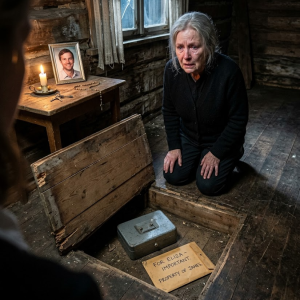
bagged every bottle, paper, and hair sample.
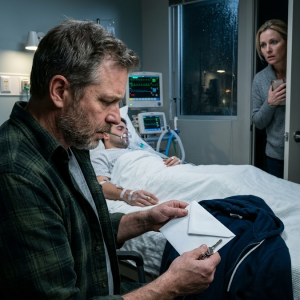
Paramedics moved Valerie onto a stretcher while Ernest rode beside her to the hospital, his hand wrapped around hers like he was trying to anchor both of them to something real.
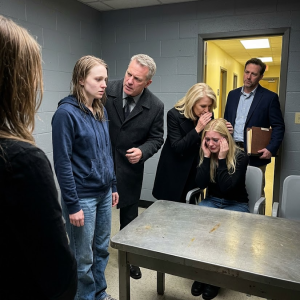
Nico gave his statement to Detective Alvarez in the kitchen, still refusing to sit down because sitting in expensive chairs seemed to make him nervous.
At Mount Sinai, the truth came in layers.
Valerie did not have cancer.
She did not have the rare autoimmune disorder Dr.
Vale had claimed to be treating.
Toxicology and the medication recovered from the house showed she had been given a rotating mix of sedatives, substances to trigger nausea and dehydration, and just enough pharmaceutical interference to make her look chronically and dangerously ill.
The IV attached to her wheelchair had been almost meaningless.
The shaved head had done the rest.
Dr.
Naomi Chen, the physician who took over Valerie’s case, explained it with the kind of careful kindness that makes bad news survivable.
Valerie would need fluids, nutrition support, counseling, and time.
Her body had been stressed, her mind manipulated, and her trust damaged.
But she was expected to recover.
Recover.
Ernest sat down when he heard the word because his legs would no longer hold him.
Valerie woke more clearly the next morning as the drugs left her system.
She looked at him for a long time before asking the question he dreaded most.
— Did you know?
— No, he said.
Then he forced himself to finish the truth.
— But I should have known something was wrong.
I should have listened to you sooner.
Valerie stared at the blanket.
— I tried to tell you I didn’t want her in my room.
Ernest bent over her hand and cried, not because tears could fix anything, but because they were the only honest thing left.
Grief had once made him feel empty.
This was different.
This was guilt with a pulse.
Lucia was charged that same day.
Dr.
Vale was arrested by evening at his clinic, where investigators found falsified records, undeclared payments, and enough evidence to destroy whatever career he thought he still had.
His gambling debts were real.
So were Lucia’s transfers to him.
The motive was exactly as cold as the paperwork suggested.
Lucia had learned the structure of Elena’s trust while helping Ernest reorganize estate files.
She knew Valerie’s eighteenth birthday was eight months away.
She knew Ernest had been signing stacks of documents without reading every line.
She knew that if Valerie were declared too ill or too cognitively impaired to assume control of her inheritance, Ernest as guardian would keep control, and Lucia as his wife would gain access through him.
Money had been part of it.
But not all of it.
During questioning, Lucia admitted something that made Ernest feel physically sick when Detective Alvarez repeated it later.
She had said, “That house still belonged to a dead woman.
Every room.
Every picture.
Even the daughter wore her face.
I was never going to matter unless the ghost was moved aside.”
Lucia had not only wanted the estate.
She had wanted replacement.
Valerie stayed in the hospital for ten days and came home to a house that no longer resembled the one she had been hurt