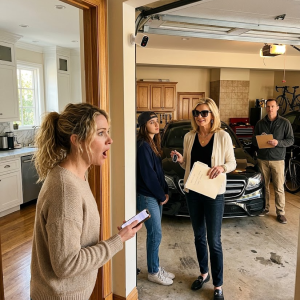
years: a man only acts that comfortable in someone else’s pain when he believes he controls the people around him.
“Maggie,” he said, as if she had arrived early for a lunch appointment, “this isn’t the best moment.”
She heard herself ask, very evenly, “You told Katie you were away for work.”
He slipped one hand into his pocket.
“I am working.”
The woman looked away, fixing her eyes on the view past the window.
She was embarrassed, Maggie realized, but not enough to leave.
Then Michael gave the smallest shrug.
“Tell Katie if you want,” he said.
“She still isn’t leaving.”
There are things so ugly they split cleanly through illusion.
That sentence did exactly that.
Maggie had watched Katie shrinking for years.
She had done what mothers often do when the truth is inconvenient and frightening: she had mistaken it for stress.
Marriage adjustment.
Job fatigue.
The ordinary erosion of adult life.
But suddenly every detail rearranged itself.
Katie had once painted huge canvases in college, bright reckless pieces that seemed almost too alive for the walls that held them.
After marrying Michael, she painted less.
Then smaller.
Then only in private.
Her laugh became quieter.
Her clothes turned neutral.
Her habit of speaking first disappeared; she began checking his face before finishing a sentence.
Maggie had seen it all and told herself not to interfere.
Now she could hear Michael’s certainty in those changes.
He believed Katie had nowhere else inside herself to go.
Maggie looked at him for one long second, nodded once, and closed the bedroom door.
She went downstairs, stepped onto the porch, and dialed Tony Russo.
Tony had known Tom since their twenties.
He had spent much of his career untangling financial arrangements built by people who thought charm was stronger than scrutiny.
He answered on the second ring.
“Maggie?”
She kept her voice low.
“I need a favor.
And I need you not to soften it for me.”
That evening, back in Raleigh, Tony sat at her kitchen counter while the tea between them went cold.
Maggie told him everything she knew about Michael’s job, his routines, the sudden trips, the way Katie had started signing papers without reading them because Michael always said he was handling things.
Tony took no notes at first.
He simply listened, fingers steepled, face unreadable.
When she finished, he finally said, “If he was arrogant enough to bring another woman to your property, the affair is probably not the whole story.
Men like that don’t compartmentalize.
They pattern.”
Maggie slept badly that night.
The next morning she went through old memories with a new kind of suspicion.
Michael had always been so polished.
He remembered birthdays.
Opened doors.
Brought expensive wine to dinner and complimented Maggie’s cooking with the ease of a man who understood how performance worked.
Tom had trusted him at first.
Maggie had, too.
There had been warning signs, but none dramatic enough to force a reckoning.
The jokes Michael made at Katie’s expense and then covered with a smile.
The way he’d answer for her in groups.
The steady pressure toward “joint planning” that somehow left Katie with less visibility over their accounts, not more.
By Tuesday morning, Tony called.
“I found irregular movement,” he said.
Maggie sat down at once.
He