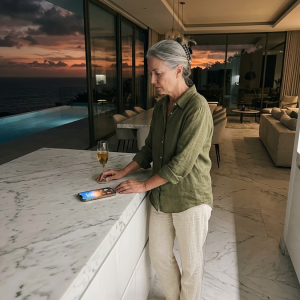
Camila was scrolling on her phone.
My father was in one of his steady, controlling moods, the kind where everything had to move around his voice.
When we finished eating, I smiled and told them I had bought a condo and would close next month.
My mother froze with her fork halfway to the sink.
Camila lifted her head.
My father set down his glass so slowly it made my skin tighten.
“What do you mean you bought a condo?” he asked.
“With my savings,” I said.
“It’s mine.”
He stood up so fast the chair legs screamed across the tile.
“Who gave you permission to make a decision like that?”
I can still hear the exact shape of that sentence.
Not because it was loud, but because it was sincere.
He meant it.
I was twenty-eight years old, employed, financially independent, and holding a set of keys in my purse.
And somehow, in his mind, I had still violated an order no one had spoken aloud: nothing I had was fully mine if the family wanted it.
Then came the part that made my mother lower her eyes.
“You’re going to sell it,” he said.
“Camila needs money for her master’s degree.
That money should be used for something important.”
Something important.
I turned to Camila.
For one second I truly believed she would stop it.
That shame would finally reach her.
That she would hear how monstrous it sounded to ask one daughter to hand over her home for another daughter’s education.
But Camila looked at the table.
She said nothing.
I told him no.
Everything after that happened fast.
He crossed the room.
His palm connected with the side of my face so hard I lost my footing and struck the edge of the table.
I tasted blood immediately.
My ears rang.
My mother gasped, but she did not get up.
Camila flinched, but she did not get up either.
It wasn’t just the pain.
It was the stillness around it.
As if my father hitting me was less shocking than me refusing him.
He pointed at the door and told me to get out if I wanted to act independent.
I remember staring at all three of them through the blur in my eyes and realizing that I was the only one in the room who thought something unforgivable had just happened.
So I left.
The drive back was a blur of streetlights, shaking hands, and humiliation so pure it felt physical.
When I got to my apartment, I pressed a towel full of ice against my cheek and looked at my reflection in the bathroom mirror.
It was swelling.
My lip was split.
I kept hearing his voice: permission, important, survive on your own.
I blocked his number that same night.
The next four days were consumed by motion.
Packing.
Signing final paperwork.
Moving boxes.
Pretending that logistics could protect me from grief.
I ignored my mother’s texts.
I ignored Camila’s one weak message that only said, Can we talk? I did not answer because I knew what she wanted.
Not accountability.
Not an apology.
Relief from feeling like the bad sister.
On the fourth day, while I was kneeling on the floor wrapping plates in newspaper, my phone lit up with my mother’s name.