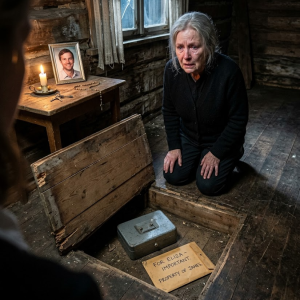
The black lock on Dorothy Haynes’s pantry door was the first thing she saw when she came home from the lawyer’s office, and for a moment she thought she was looking at something that belonged in another person’s life.
It hung there in the center of her kitchen like an insult made physical.
Heavy.
Matte black.
Industrial.
Too deliberate to be a joke, too calm to be an accident.
Dorothy stood in the doorway with her purse still on her shoulder and watched the late-October light settle in long copper strips across the floorboards.
The maples outside Elmwood Drive had turned the deep red that only Canadian autumn seems to manage, and the whole evening looked beautiful enough to hurt.
Inside the house, though, something had shifted.
For thirty-one years Dorothy had worked as a registered nurse at St.
Michael’s Hospital in Toronto.
She had seen men in shock try to tell jokes through pain.
She had seen women sit beside hospital beds for twenty straight hours and still apologize for needing water.
She had seen the look on a person’s face when their life had just changed and their brain was refusing to catch up.
Nursing gave you a kind of discipline.
You learned not to panic because panic wasted time.
You learned to read the room before you filled it with emotion.
You learned that some of the most serious things in life arrived wearing ordinary clothes.
So she did what thirty-one years had trained her to do.
She assessed.
The lock had been fed through the pantry handle and around a small metal bracket screwed into the door frame.
Someone had measured.
Someone had drilled.
Someone had stood in Dorothy’s kitchen long enough to decide she no longer needed free access to the food shelves in her own home.
Her daughter-in-law came around the corner holding a mug of tea with both hands.
Clare was thirty-six, polished in a way Dorothy had never entirely trusted.
Not glamorous exactly.
Controlled.
Her blonde hair always smooth, her nails always neat, her voice always pitched to sound reasonable even when she was saying something outrageous.
She dressed like someone who expected every room to organize itself around her.
“Oh,” Clare said, as if Dorothy had caught sight of a new lamp.
“You saw that.”
Dorothy set her purse on the counter.
“I did.”
“We needed a better system.” Clare nodded toward the pantry.
“Derek and I buy our own groceries, and it was all getting mixed together.
This just makes more sense.”
Dorothy looked from the lock to Clare’s face.
“That’s my pantry.”
Clare took a small sip.
“It’s a shared space.”
Shared.
The word landed harder than the lock had.
Dorothy said nothing else.
She took off her scarf, hung it on the hook by the back door, placed her keys in the blue ceramic bowl she had used since her husband Gerald died fourteen years earlier, and stood still long enough to feel the shape of her anger before she touched it.
She had let her son Derek and his wife move in eight months earlier.
At first, it had sounded temporary.
Derek had come over one Sunday afternoon looking tired and embarrassed.
Their condo fees had gone up, he said.
Clare’s freelance contracts had become inconsistent.
They