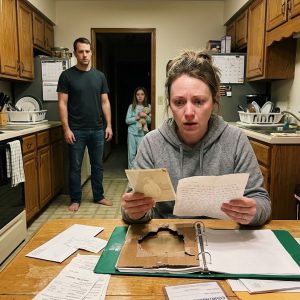
The ride to the hospital was a blur of red lights, sharp turns, and desperate silence. Carlos held Mariana in the back seat while Luisa pressed towels to the mattress beneath her. Teresa sat in front gripping her skirt so tightly that her knuckles ached. Nobody scolded her. Nobody needed to. Carlos’s silence was more terrible than any words. At the emergency entrance, nurses rushed Mariana through swinging doors while Carlos disappeared after them. Teresa was left under the fluorescent lights of the waiting area, staring at her own reflection in a dark window and thinking of the moment she had lifted the blanket.
A young doctor came out nearly an hour later. Mariana was about ten weeks pregnant, he explained. The bleeding had been caused by a threatened miscarriage brought on by exhaustion, dehydration, and physical strain. They had managed to stabilize her for the moment, but she needed rest, medication, observation, and above all, peace. The baby still had a heartbeat. Nothing was guaranteed. Carlos dropped into a chair and covered his face with both hands. Teresa did not sit. The words ten weeks pregnant seemed to hang in the air, refusing to settle. She had spent the morning accusing a sleeping woman of laziness when that woman had spent the night trying not to lose her child.
Carlos lifted his head at last and looked at his mother with a grief sharpened by anger. He asked whether she was satisfied now. He asked whether a clean kitchen had been worth more to her than the life upstairs. Teresa opened her mouth to defend herself, to say she had not known, to say no one had told her, to say the house had been full of work and her back was killing her and she was tired. Every excuse turned to ash before it reached her tongue. The doctor had already spoken. None of it mattered. Carlos stood and told her that Mariana had tried all week to please her, that he had watched his wife drag chairs, carry dishes, smile through dizziness, and apologize for sitting down. Then he turned away because he could not bear to look at her.
In that waiting room, Teresa was suddenly no longer an older woman in sensible shoes and a stiff blouse. She was nineteen again, standing in another house, another kitchen, with another older woman judging every movement she made. She remembered her own first pregnancy, the one no one spoke of anymore because it had ended before there was a cradle to buy. She had carried pails of water up a narrow back step while already cramping. She had been told women in the family did not rest for every little complaint. When she began bleeding, her mother-in-law called her weak before anyone called a doctor. Teresa had lost that baby before nightfall. Her husband, ashamed and grieving, had buried the pain under silence. Teresa had buried it under work. She had spent years hating the woman who hardened her life. Somewhere along the way, without admitting it, she had copied her.
When the memory struck fully, Teresa bent forward in her chair and pressed a fist against her mouth. It was not just guilt she felt. It was recognition. The stain on Mariana’s sheet had opened a door Teresa thought she had sealed forever. She saw now what hardness had done to her. It had preserved her, yes, but it had also hollowed her out. It had taught her how to survive without teaching her how to love gently. She had mistaken endurance for virtue and control for care. And a young woman had nearly paid for that confusion with a child.