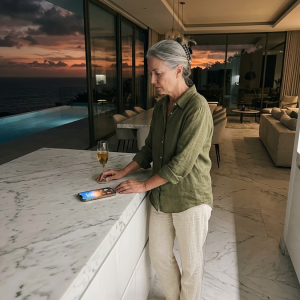
checking her phone every four minutes.
It felt less like becoming rich than becoming unowned.
Three months later, Patricia asked to meet for lunch.
Olivia almost declined.
Then she agreed.
They met in a small restaurant halfway between Westport and New Haven, somewhere too plain for performance.
Patricia arrived early and looked smaller than Olivia remembered.
There was no shawl this time.
No stage lighting.
No audience.
“I wanted to say I was wrong,” Patricia said after the menus were cleared.
“Not politically wrong.
Not tactically wrong.
Morally wrong.”
Olivia listened.
“I taught myself to confuse support with usefulness,” Patricia went on.
“You were steady, so I leaned on you.
Harrison was fragile in ways that demanded rescue, so I called that need.
I see now what that made of you in this family.”
It was the closest thing to truth Olivia had ever heard from her mother.
“Thank you for saying it,” she replied.
Patricia’s eyes filled.
“Can you forgive me?”
Olivia took a breath before answering.
“I can stop carrying you,” she said.
“I’m still deciding what forgiveness looks like.”
Patricia nodded slowly.
It hurt her, Olivia could see that.
But for once, the hurt was not being outsourced.
As for Harrison, he sent one email six months later.
No greeting.
No apology.
Just a tight, bitter paragraph accusing Olivia of choosing legal righteousness over blood loyalty.
She read it once and archived it.
That, more than anything, told her the story was finished.
Some people lost everything and still never located the exact moment they had been wrong.
On the first snowy night of the following winter, Olivia drove past the old property on her way back from a dinner in town.
The porch light was on.
The driveway looked the same.
For a moment, she pulled over across the street and watched the flakes drift down in the beams of her headlights.
A year earlier, she had walked into that weather carrying a split suitcase and the full weight of a family that mistook access for love.
Now she sat in the warmth, her own keys in her coat pocket, her own accounts protected, her own future answered to by no one.
She did not feel triumphant.
Triumph would have been too simple for what it cost.
What she felt was cleaner than that.
She felt free.
Then she drove on.
Some people would say money revealed her family for who they were.
Olivia thought that was only half true.
Money had not created the cruelty on that driveway.
It had only removed their reason to disguise it.
The harder question was the one that lingered after everything was legally resolved and emotionally named: whether a family that loves you only once your worth becomes visible ever loved you at all, or whether it simply learned too late that you were never theirs to use.