out of his hands.
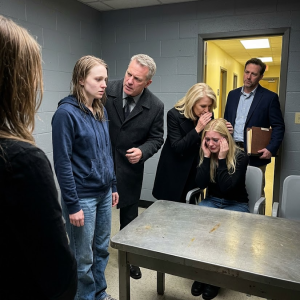
The officer asked him to lower his voice.
Instead, Dad said the sentence that ended everything.
‘I fed her.
I clothed her.
The least she can do is pay for her sister.’
Nobody in the room moved for a second.
Then Delaney covered her mouth with both hands, like she had been slapped by something she couldn’t see.
The bursar turned the fraud form toward me.
I signed it.
Security escorted Dad out.
Mom followed him, still trying to whisper the disaster smaller.
Delaney stayed in her chair, crying so quietly it was worse than screaming.
For the first time in my life, I couldn’t tell whether she was crying for herself, for me, or because the story she had lived in was collapsing right in front of her.
Before I left, the bursar connected Delaney with a financial aid counselor and removed me completely from the account.
They told her she would have to arrange her own plan if she wanted to stay enrolled.
She didn’t look at me when they said it.
Two days later, the detective handling the laptop report called.
The pawn shop had held the computer after seeing the police record, and the sale ticket clearly showed Dad had brought it in.
Once I proved ownership, they released it back to me.
The corner was scratched and the battery was half dead, but when I opened it and saw my scholarship essay still there, I had to sit down.
The rest took longer.
The fraudulent accounts on my credit report were investigated and closed.
Dad ended up having to repay the laptop money and the balances tied to the accounts he had opened in my name.
Mom left me three voicemails about how I had ruined the family and one more about how families should protect each other.
I saved them all and never replied.
Delaney lost that semester.
I used to think that fact would make me feel guilty.
It didn’t.
She was twenty, not ten.
Old enough to ask why my card kept appearing every time her life needed funding.
Old enough to notice who was always being asked to give something up.
Still, six months later she sent me a text I read three times before I believed it was real.
‘I didn’t know he used your name.
I knew they leaned on you.
I just didn’t know how bad.’
I never answered.
Not because I had no feelings left.
Because I finally understood that answering every cry for understanding had been the job they assigned me before I was old enough to refuse it.
I stayed in Miss Carla’s spare room until I had enough saved to rent a studio near work.
I finished my scholarship essay on the same laptop Dad had tried to turn into cash.
I got the scholarship too.
The day the acceptance email came in, I sat on my mattress on the floor and laughed so hard I scared myself.
Dad still called from unknown numbers for a while.
Then he stopped.
Mom sent one holiday text that said, We miss you, as if absence had simply happened to them.
Delaney re-enrolled the following year with grants, a campus job, and, from what I heard through an aunt, a much clearer understanding