found a way to fund it and then acted wounded if anyone asked practical questions.
So when Nolan announced that he and his new wife Brooke were taking a once-in-a-lifetime honeymoon to Costa Rica, I raised an eyebrow.
Nolan’s work history was a patchwork of short jobs, long “transition periods,” and big speeches about future plans.
My parents had spent the previous six months telling everyone they needed to tighten their belts.
“How are you affording Costa Rica?” I asked my mother one afternoon while she wrapped leftover casserole in foil.
She smiled too brightly.
“Nolan has it covered.”
The answer landed wrong, but in my family, asking a second question often opened a trapdoor.
I let it go because keeping the peace is a habit people like my parents train into you early.
Two weeks later, Sophia left for a three-week summer music program in Colorado.
She packed with the seriousness only teenagers and surgeons seem to have, rolling her clothes, labeling folders, checking her violin case three times.
Right before we left for the airport, she opened her satin-lined jewelry box and set the ring inside with both hands.
“I don’t want to lose it at camp,” she said.
Then she looked at me with that serious, open face fifteen-year-olds still have before life teaches them to hide.
“Can you keep an eye on it?”
I promised I would.
I meant it.
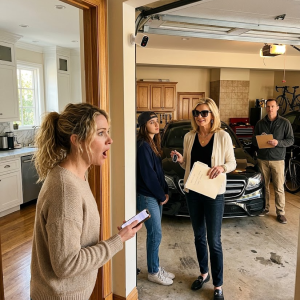
Two days after she left, my parents showed up at my house uninvited.
My father carried a paper bag of blueberry muffins, as if carbs could make trespassing feel affectionate.
My mother walked in first and said, “We were in the neighborhood,” even though nobody is ever casually in my neighborhood unless they mean to be.
I was at the sink rinsing dishes when she drifted toward Sophia’s room.
“What are you doing?” I called.
She didn’t turn around.
“Looking for an old book.
I thought I left it in there last time.”
There was no old book.
My mother had never sat in Sophia’s room long enough to forget one.
But years of being told I was too sensitive had trained me to hesitate at the exact moment certainty was needed.
After they left, Sophia’s jewelry box sat slightly off-center on her dresser.
It was a tiny thing, the sort of detail another person would never notice.
But I had made her bed that morning.
I had dusted that surface.
I knew exactly how that box had been sitting.
I opened it anyway.
The ring was still there.
For one hopeful second, I nearly laughed at myself.
Then I picked it up.
The stone was wrong.
The original sapphire had always looked deep, almost ink-dark unless sunlight struck it at an angle.
This stone threw back a hard, eager sparkle.
It looked too alive in the wrong way, like it was trying to impress me.
I stood there in my daughter’s room, ring in hand, arguing with my own eyes because believing them meant believing something worse.
The next morning I took it to a jeweler named Mara, the same woman who had repaired my wedding band years earlier.
She put on her loupe, held the ring beneath her lamp for less than ten seconds, and then looked up at me with professional caution.
“This