a man who never once confused my self-sufficiency for a lack of need.
I became competent, steady, the doctor other people trusted at their worst moment.
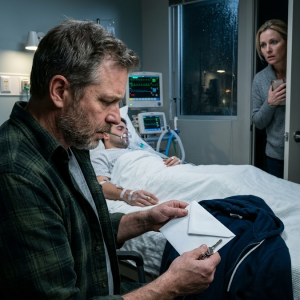
And still, some part of me remained twenty-seven years old, holding a returned envelope.
After surgery, I found my parents in the waiting area outside ICU.
My mother stood the moment she saw me.
My father rose more slowly, like his body had aged three years in one night.
No one spoke at first.
The vending machines hummed.
Somewhere down the hall, a monitor alarmed and stopped.
My hands still smelled faintly of chlorhexidine.
My scrubs were marked where Monica’s blood had soaked through my gown.
‘She’s alive,’ I said.
‘The next twenty-four hours matter, but she’s stable enough for now.’
My mother put a hand over her mouth and started crying again.
My father stared at me in a way I had wanted him to, once.
Not because he was proud.
Because he finally had to reconcile me with the story he had believed.
He said, very quietly, ‘You really are a doctor.’
Something in me went cold at that.
‘Yes,’ I said.
‘I always was becoming one.’
My mother shook her head.
‘Monica told us you left school.
She said—’
‘I know what she said.’
My father looked like he wanted to sit down and couldn’t trust his knees.
‘She showed us messages.’
‘Then they were fake.’
Silence again, but this time it had weight.
I told them about the leave of absence.
About Sarah.
About the dean’s approval.
About the paperwork I had mailed and the letters they never opened.
My mother started whispering no under her breath, not because she doubted me anymore but because she was replaying herself inside the choices she had made.
My father asked one question that still makes my chest tighten when I think about it.
‘Why didn’t you come home?’
I looked at him for a long second before I answered.
‘You told me not to contact you until I was ready to tell the truth.
I was already telling it.’
The next morning, after Monica was extubated and transferred out of critical status, she asked for water, then pain medication, then finally for our mother.
A nurse told me she seemed agitated and kept asking if I was still in the building.
I should have gone home.
Instead, I walked into her room with my parents standing on either side of the bed.
Monica looked terrible.
Pale under hospital light, bruises darkening along her jaw, one arm immobilized, lips dry from oxygen.
For the first time in my life, she had no performance available to her.
Pain had stripped her down to something raw and frightened.
Her eyes went straight to me.
No one said hello.
My mother was the one who broke first.
She asked, voice shaking, whether Monica had lied about me.
Not misunderstood.
Not gotten confused.
Lied.
Monica looked at our father, then at me, and I watched calculation move through her face like an old reflex trying to wake up.
It was subtle, but I knew it too well.
The pause before she chose which version of reality might save her.
‘I told you what Irene told me,’ she said.
I stepped closer to the bed.
‘No,’ I said.