did not make me hopeful.
It made me stubborn.
That was how I found the altar in the far corner.
It was small, wooden, neglected, and immediately familiar.
I had seen Neftali carry it years ago with unexpected care.
He had laughed when I asked why he bothered with such an old thing.
“Because some things matter only if you keep them,” he had said.
At the time I thought he meant memory.
Standing in the cabin years later, I wondered if he had meant something else.
I cleaned the altar and placed his photograph on it.
Then I searched the kitchen shelves for anything that could hold a candle.
I found an iron candlestick, heavy and ugly, black with age.
When I carried it back, it slipped from my hand and crashed onto the floor.
The sound was hollow.
I knew it at once.
Not because I was clever, but because grief had sharpened every nerve in me.
In that terrible silence, any false note rang like a bell.
I knelt, ran my fingertips over the floorboards, and felt the seam.
The board lifted with resistance, as if it had not been touched in years.
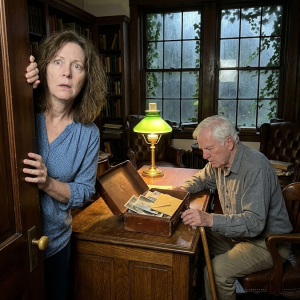
Underneath sat a metal box and a manila envelope wrapped against damp.
On the front of the envelope was a single word in Neftali’s handwriting.
Mom.
I stood there holding the envelope, unable to open it.
There are moments when the truth feels like a cliff edge.
You know stepping forward will change everything behind you.
At last I slid my thumb beneath the flap.
Inside was a letter, three pages thick, and a small brass key taped to the back of the final sheet.
My hands shook so badly I could barely unfold the paper.
Mom,
if you’re reading this, it means one of two things.
Either I finally told the truth and asked you to come here with me, or I died before I could do what I should have done a long time ago.
The room tilted.
I sat on the floor because my legs would not hold me.
The letter was not written in a rush.
He had dated it eight months earlier.
Every line was steady, deliberate.
That hurt more somehow.
It meant he had been carrying his fear quietly while eating dinner with us, while kissing his wife goodbye, while telling me not to worry.
He wrote that he had discovered Renata had been moving money out of business accounts he controlled through shell companies he had never approved.
At first he believed it was a mistake.
Then he found signatures forged well enough to pass a quick review.
Then he found private messages between Renata and a man named Álvaro, a financial consultant who was much more than that.
I had never heard the name.
Neftali wrote that the affair did not wound him as deeply as the fraud.
That sentence broke my heart in a new way.
Betrayal in marriage was one pain.
Betrayal built around greed was another.
He said he had confronted her once, indirectly, and watched her lie to his face with such ease that he understood then he was in danger if he showed what he knew.
He had begun collecting evidence.
In the metal box, he wrote, were copies of transfers,