the counter, and called emergency services.
I remember the dispatcher asking whether the child was breathing.
I remember saying yes and then no and then I don’t know because my hands were shaking so hard I couldn’t even tell what I was looking at through the blood.
Vanessa stood back from the table breathing heavily, still furious, as if she had been wronged.
My mother moved toward her then, not Ruby, touching her elbows, telling her to sit down, telling her not to say anything until she had calmed herself.
The betrayal of that rearranged my bones.
When the paramedics came through the door, their faces changed instantly.
One went straight to Ruby and started checking her airway and pupils.
The other looked at my parents still hovering over me and snapped, ‘Step away from her now.’
Authority did what decency had not.
My father let go.
I dropped beside the stretcher as they worked.
Ruby’s hand was cold and damp in mine.
One of the paramedics asked what happened, and before my mother could open her mouth, I said, ‘Her aunt slammed her into the table.’ I said it loud.
I said it clearly.
I needed the truth to exist somewhere outside that house.
The paramedic’s eyes flicked to Vanessa, then to the blood on the floor, and I watched him make a decision.
He stepped away and called for law enforcement while the other secured Ruby’s neck, started oxygen, and got her onto the stretcher.
I heard the words child assault and urgent transport.
At the hospital, they took Ruby through double doors while I stood in a corridor with her blood drying on my shirt.
A nurse cleaned my scraped hands because I hadn’t realized I’d cut them on broken porcelain.
A police officer asked for names.
Another asked who had been present.
I answered in a voice that sounded borrowed.
The doctor found me less than an hour later, though it felt like a century.
He held scans in one hand and wore that careful expression medical professionals use when the truth is too large to deliver quickly.
He told me Ruby had an orbital fracture on the left side, severe swelling, and damage behind the eye consistent with blunt-force trauma.
They could operate.
They could reduce pressure.
They could protect what they could protect.
Then he said the sentence that set the rest of my life on fire: Ruby would never recover full vision in her left eye.
I sat down because my knees stopped being trustworthy.
I remember staring at a scuff mark on the hospital floor while he kept talking about specialists and follow-up care and percentages.
All I could hear was never and left eye and six years old.
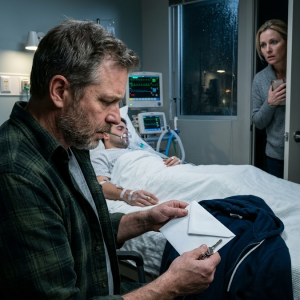
When Ruby woke up after surgery, one side of her face was swollen and bandaged.
She reached for me automatically.
Then she blinked at the ceiling and asked, very softly, ‘Mommy, why is that side dark?’
There are moments when grief stops being abstract and becomes a physical object.
That question was one.
I smiled because she needed my face to hold, and I told her the room would look strange for a while.
Then I stepped into the hallway and folded over into my own hands so she wouldn’t hear the sound