as if she was trying to convince herself before anyone else.
‘Noah said he was going to you.
He said he had proof.
Dad told me he just wanted to scare him, to get the files back.
I thought…’
She stopped.
‘You thought what?’ I asked.
Her face crumpled.
‘I thought if Noah calmed down, we could fix it.’
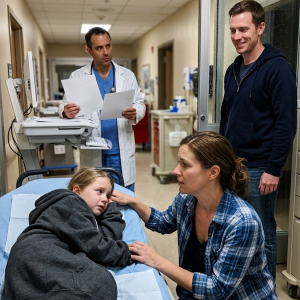
I looked through the glass at our son, lying still beneath the machines.
‘You fixed nothing.’
The detectives separated them.
Walter shouted at first.
Then he lowered his voice and tried to become reasonable.
Men like Walter always believed volume and calm were both tools, interchangeable depending on the audience.
But Noah had known him too well.
The evidence was clean.
Organized.
Backed up twice.
Bank statements.
Emails.
Recordings.
Video.
Names.
Dates.
Motives.
Noah had built a case from inside his own heartbreak.
Walter was arrested that night on charges that began with fraud and escalated once investigators reviewed the dash camera footage.
Elise was not put in handcuffs in the ICU, but she was escorted to another room and questioned for hours.
I stayed with Noah.
At dawn, his fingers moved.
It was so slight the nurse almost missed it.
A twitch.
A flutter against the sheet.
I leaned over him, afraid to hope, afraid not to.
‘Noah,’ I said.
‘It’s Dad.’
His eyelids did not open.
But his fingers moved again.
The next days were not the miracle people imagine when they hear survival stories.
They were brutal.
Slow.
Full of machines, swelling, infections, setbacks, whispered conversations in hallways, and doctors who used careful words because they did not want to build a future they could not promise.
But Noah stayed.
He stayed through the first surgery.
Then the second.
He stayed when they reduced the medication.
He stayed when he finally opened his eyes and looked at me like he was seeing me from the bottom of deep water.
The first word he tried to say was not Mom.
It was not Grandpa.
It was Dad.
I held his hand and cried in a way I had refused to cry before.
He could not squeeze hard, but he squeezed.
Weeks later, when he was strong enough to understand pieces of what had happened, I told him the truth carefully.
Not all at once.
Not the ugliest details.
The doctors warned me that stress could hurt his recovery, but Noah had already carried the truth alone.
I would not make him carry lies too.
He listened with his eyes closed.
When I finished, he whispered, ‘Did she know?’
I did not pretend not to understand.
‘She knew about the money,’ I said.
‘She knew you were trying to tell me.
She says she didn’t know your grandfather would follow you.’
A tear slid into his hairline.
For a long time, he said nothing.
Then he asked, ‘Do you believe her?’
That question has never left me.
Elise wrote letters from her sister’s house, then through her attorney, then by hand when the legal language stopped working.
She said she was sorry.
She said Walter had controlled her for years.
She said she was scared of losing the house, scared of prison, scared of me finding out she had let her father use Noah’s trust to keep his business alive.