version of before, but because shame is dangerous in isolation.
The first week, we could barely sit across from each other without both of us thinking about that kitchen table, that lie, that blank signature line waiting for my hand.
Trust does not come home in one piece after something like that.
It returns slowly, if it returns at all.
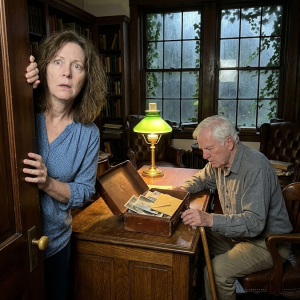
One night about a month later, we were in Michael’s study sorting unopened wedding gifts to return.
Emma picked up his old fountain pen and burst into tears so suddenly she folded in half.
“I should have known,” she said.
“I kept telling myself love meant giving him the benefit of the doubt.
I kept telling myself he sounded certain, and maybe certainty was what adulthood felt like.” I sat beside her and said the truest thing I had learned in those forty-eight hours: “Certainty and control are not the same thing.”
We never used the wedding album.
The photographer sent a proof gallery, and I couldn’t make myself open it for weeks.
When I finally did, I found one image of Emma just before the ceremony, standing alone near a stained-glass window with her mouth set like she was bracing for weather.
I realized then that some part of her had known she was walking toward something wrong.
She just hadn’t named it in time.
People still have opinions about what I should have done.
Some say I should have stopped the ceremony the minute Nora confirmed the documents and spared my daughter the public humiliation of a wedding-night collapse.
Others say Emma was manipulated, young, in love, and terrified, and that the cruelest person in the room was always Grant.
Both may be true.
I know only this: the worst sentence I heard that week was not “power of attorney” or “transfer within seventy-two hours.” It was Grant telling Emma, “You’re helping.” Because that is how betrayal enters decent hearts.
It does not always ask them to become monsters.
Sometimes it only asks them to stay quiet long enough for love to become leverage.
Emma chose me in the end.
I am grateful for that, and I grieve how close she came to choosing otherwise.
Maybe that is what remains after the papers are burned and the guests go home: not the question of who was wrong, because that part is easy, but whether forgiveness begins the moment someone finally steps back from the edge, or only after you can trust them not to walk you there again.