never managed to destroy.
She looked at it under the kitchen light for a long time.
There was almost nothing to see but blur and grain, yet she cried as if someone had handed her a whole missing year.
Michael stood at the sink with both hands braced on the counter, facing the dark window.
He did not try to comfort her.
That, at least, remained true to the life they had built out of damage.
When morning came, Susan felt wrung out and strangely clear.
She made coffee out of habit, poured one cup for herself, one for Michael, and set his near his elbow without speaking.
Then she sat down and said the one sentence she understood at last.
“I can live with the fact that I betrayed you,” she said.
“I cannot live with the fact that you decided ignorance was the price of staying married to me.”
Michael did not argue.
He stared at the steam rising from his cup and nodded once, as though he had been expecting those words for years.
That afternoon she called Jake.
He was thirty-one now, with a mortgage, a wife, and a toddler who liked to climb into Susan’s lap and pat her cheeks with sticky hands.
She did not tell him every detail over the phone.
She only said that something buried from 2008 had come to light, and that she and his father were finally ending what had, in truth, ended long ago.
Jake was quiet for a beat.
Then he said, softly, “I always knew something died in that house that year.
I just never knew what it was.” Susan cried after she hung up, because children notice more than parents survive admitting.
The divorce moved quickly, almost indecently quickly for a marriage that had lasted thirty-six years on paper.
There were no shouting matches over furniture, no war over accounts, no last-minute pleas.
Michael signed everything without contest.
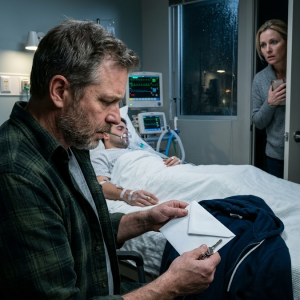
On the day Susan packed the last box from the guest room, he stood in the doorway holding the hospital envelope one final time.
“You should keep it,” he said.
“It’s yours.”
She took it, though the weight of it still felt unnatural in her hands.
“It always was,” she replied.
Weeks later, after she had settled into a small condo near the river, Susan requested the full hospital record anyway.
She needed confirmation from somewhere outside both of them, something clean and official after eighteen years of living inside emotion.
The file said what Michael had said: positive pregnancy test, hemorrhaging, fetal cardiac activity absent, emergency dilation and curettage performed with spousal consent while patient unconscious following overdose.
There was no dramatic hidden sterilization, no conspiracy, no second villain waiting behind a curtain.
The truth was simpler and somehow crueler.
He had saved her life and stolen her right to know its shape.
She sat with those papers for a long time at her dining table, the late light turning them amber.
For the first time, she allowed herself to grieve two things separately instead of as one hard knot: the child that had existed just long enough to leave a scar, and the marriage that had gone on living long after its heart stopped.
She did not excuse herself for the affair.
She did not