make forty years sound like a housekeeping contract.
Marcus continued, each syllable heavier than the last.
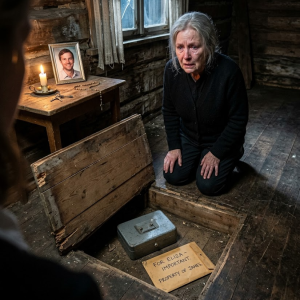
Richard left Peggy only one property at 47 Oakwood Lane in Milbrook, Massachusetts, with all contents therein.
She was to vacate Brookline within thirty days of his death.
Only.
The word lodged inside her like a splinter she knew would work deeper when she tried to ignore it.
Marcus slid a brown envelope toward her.
Inside was an iron key gone orange at the edges and a folded paper with an address written in Richard’s narrow, exact handwriting.
Peggy stared at the envelope without touching it until Steven shifted in his chair and said, almost cheerfully, ‘Thirty days is fair.’
Catherine clasped her hands.
‘You’ll land on your feet, Peggy.
Whatever that place is, you can sell it.’
Michael glanced up from his phone.
‘Dad was practical.’
Practical.
Peggy wanted to laugh and scream at once.
Richard had been many things: controlled, difficult, brilliant, vain, withholding.
But practical was the word people used when they wanted to make cruelty sound mature.
She picked up the key.
It was cold enough to make her fingertips ache.
The next month passed in an ugly blur.
Steven had real estate people walking through Brookline before Richard’s suit had been sent back from the funeral home.
Catherine put colored tabs on silver patterns and asked for lists of what was antique and what was merely old.
Michael drank from the wine cellar with friends one Saturday afternoon and left two crystal glasses on a side table for Peggy to clear away.
At first Peggy moved as if routine might save her.
She folded linens.
Sorted drawers.
Packed winter sweaters into boxes.
But every room had become hostile, no longer because Richard was gone, but because his absence had freed his children to express what they had spent years polishing into social acceptability.
She heard Steven in the library one morning saying into his phone, ‘No, she won’t be a problem.
She got some shack in the woods.’
That afternoon Catherine found her wrapping dishes and said, ‘The guest room furniture should remain.
It belongs with the house.’
Peggy turned and looked at her.
‘I slept in that room with your father for thirty-eight years.’
Catherine didn’t blink.
‘And now it’s part of the estate.’
For the first time in the entire miserable month, Peggy felt something hot and clean move through her.
She set the plate in her hand back into the packing paper and said, ‘Then you can wrap your own china.’
Catherine’s nostrils flared, but she left.
Marcus called once, quietly, to ask whether she needed help finding a moving company.
There was an odd note in his voice, as if he were trying to say something he had no right to say.
Before he hung up, he added, ‘Richard never did anything casually.’
Peggy almost answered, He humiliated me casually enough.
But she was too tired.
On the thirtieth morning, she packed only what felt like it still belonged to her.
Two suitcases.
Her mother’s brooch.
A box of letters from before Richard.
A few books with cracked spines.
And from the bedroom drawer, the framed black-and-white photo from their wedding day.
In the picture, she was twenty-nine and hopeful.
Richard was older, elegant, unreadable,