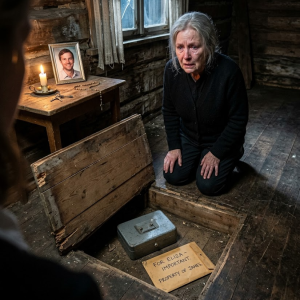
but he was looking at her instead of the camera.
It had always been the one image that made her believe some private tenderness had existed, even when he made it hard to prove.
Nobody came to the front door when she carried her bags out.
The movers Steven hired were already measuring a hallway inside.
Peggy set the wedding picture on the passenger seat, started the car, and drove west.
Milbrook was smaller than she imagined.
The highway gave way to a state road, then to a narrow two-lane strip with woods pressing close on both sides.
A diner with a flickering neon coffee cup marked the center of town.
Beyond it, the road dipped, curved, and nearly disappeared into dense trees.
Oakwood Lane was less a lane than a private thought.
Gravel crunched under her tires as the forest thickened.
Peggy tightened both hands on the wheel and prepared herself for the sight of collapse.
Instead, the trees opened and she stopped breathing.
The house at 47 Oakwood Lane was not a mansion.
It was better than a mansion.
It looked intentional.
Loved.
A cedar-sided home sat in a clearing ringed by pine and maple, with a wide porch, a chimney of fieldstone, green shutters, and an oak front door that looked as if someone had rubbed oil into it for years.
Ferns grew along the path.
Window boxes held late white petunias that had been watered recently.
Peggy remained in the car long enough for the engine tick to go silent.
She had spent the whole drive rehearsing resentment, and now she didn’t know what to do with it.
The key fit the front lock perfectly.
When the door opened, a cool, pine-scented hush met her.
Sunlight slanted through the front windows onto polished floors.
There were bookshelves built into the walls, a braided rug by a stone fireplace, and a long table by the window with a lamp already plugged in.
Somebody had made sure the electricity worked.
Somebody had stocked the kitchen with sealed tins of tea, paper-wrapped soap, and clean glass canisters.
Then Peggy looked up.
Every wall held photographs.
Not formal portraits.
Not social snapshots.
Candid photographs, hundreds of them, framed and hung with obsessive care.
Peggy in the Brookline garden kneeling over roses.
Peggy laughing in an apron, a smear of flour on her cheek.
Peggy half asleep with an open novel over her chest.
Peggy on the hospital bench the night Richard had chest pains, her coat pulled close, her face drawn and terrified.
Peggy on the back steps in autumn, staring at falling leaves.
Peggy brushing snow off a windshield.
Peggy standing at a sink with yellow gloves and her head tipped back in a laugh he must have caused.
A sound left her that was too broken to be called a sob.
Richard had seen her.
Not the polished hostess.
Not the suitable wife at the edge of banquet tables.
Her.
The private woman moving through ordinary moments he had apparently been collecting for years without telling her.
She moved slowly from frame to frame, one hand over her mouth.
Some photos were decades old.
Her hair changed.
Her face softened and sharpened with time.
Her clothes shifted through the years.
But the gaze behind the camera never wavered.