softened when he saw Noah asleep against me, his little hand still fisted in my shirt.
I showed them the note.
The older officer read it twice.
His mouth pressed into a hard line.
“Did she say this was her handwriting?” he asked.
“She said she left a note.”
The younger officer photographed the nursery, the crib, the sink, the trash, the suitcase.
The older one asked me to repeat the phone call as clearly as I could remember it.
I did, though my voice shook at the part where she laughed.
CPS arrived less than an hour later.
The woman who came was named Dana.
She had gray streaks in her dark hair and a voice that stayed calm even when her eyes told me she was angry.
She examined the note without touching it, then looked at Noah’s crib, then the bottles in the sink.
“Has he been seen by a doctor?” she asked.
“Not yet.
I changed him and fed him first.”
“We’re going now,” she said.
The officers followed us to the emergency room.
Noah woke when I buckled him into the car seat I kept in my truck for visits.
He started crying again the second I lowered him into it, and I nearly came undone right there in the driveway.
“He thinks he’s being left,” Dana said quietly.
I looked at her.
She did not say anything else.
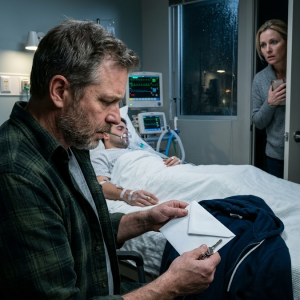
At the hospital, a nurse checked his temperature, hydration, skin, and weight.
She spoke softly to him, but Noah kept watching the door.
Every time someone entered or left, his eyes widened.
When she removed the fresh diaper to examine the rash, her expression changed.
“How long was he left?” she asked.
“I don’t know exactly,” I said.
“My daughter flew out this morning.”
The nurse looked at Dana.
Dana wrote something down.
That night, I sat under fluorescent lights with Noah sleeping against me in a clean hospital blanket while my phone lit up over and over.
Dad, answer me.
You’re overreacting.
He’s fine now, right?
You better not embarrass me.
Then one that made me stare at the screen until my eyes burned.
Do you know how hard it is to be a mom? One week won’t kill him.
I took a screenshot and handed the phone to Dana.
She read it without changing expression.
“May I document this?” she asked.
“Yes.”
By midnight, an emergency placement had been arranged.
Noah would come home with me, pending the court hearing.
I signed papers with hands that felt older than they had that morning.
When I carried him into my house just before dawn, the sky was turning pale gray.
I had already set up the portable crib from the closet.
My late wife had insisted I buy it when Noah was born, even though Melissa said it was unnecessary.
“Grandbabies need a place at Grandpa’s,” she had told me.
She had been gone eight months by then, and for the first time since her funeral, I was grateful for something that hurt to remember.
Noah slept for thirteen hours, waking only to drink and cry when he thought I had moved too far away.
I sat beside the crib most of the day, one hand resting between the slats so he could hold my