worse than the airport.
Melissa arrived in a blazer I had bought her for a job interview she quit after three weeks.
She looked smaller without the sunglasses and beach glow.
Her lawyer told the judge she had experienced severe stress, that she had made an error in judgment, that her father had intervened before any permanent harm occurred.
Then Dana handed over the photographs.
The bottles.
The crib.
The rash.
The note.
The text messages.
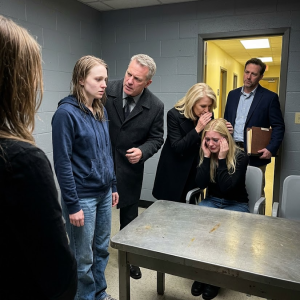
The courtroom went very still when the judge read the note aloud.
Went to the Bahamas with girlfriends – back next week.
Baby will be fine.
Melissa stared at the table.
For the first time since I found Noah, she did not laugh.
The judge asked her one question.
“Who did you arrange to care for your child?”
Melissa swallowed.
Her lawyer touched her arm, but Melissa spoke anyway.
“I thought my friend might check on him.”
“You thought?”
“I mentioned it.”
“Did she agree?”
Melissa’s lips parted, then closed.
The judge waited.
Finally, Melissa whispered, “No.”
It was not loud, but it landed everywhere.
No arrangement.
No caregiver.
No plan.
Just a baby in a crib and a mother on a plane.
Temporary custody was granted to me that afternoon.
Melissa was ordered to have no unsupervised contact with Noah, to complete evaluations, parenting classes, and every requirement the court set before any future reunification could even be considered.
The criminal case would move separately.
When the judge finished, Melissa turned in her chair and looked at me.
Her eyes were red, but I still could not tell if she was crying for Noah or for herself.
“He’s my son,” she said.
I nodded.
“Yes,” I told her.
“And that is exactly why this happened.”
Months passed.
Noah healed faster on the outside than he did on the inside.
The rash disappeared.
His appetite came back.
His cheeks filled out.
But for a long time, he cried if I closed a door.
He cried if a cartoon played too long.
He cried if he woke up alone in the crib and could not see me.
So I moved the chair beside his bed and sat there every night until he learned that sleep did not mean abandonment.
Melissa visited under supervision after several weeks.
The first visit lasted twenty minutes.
She brought a stuffed turtle from the Bahamas gift shop.
Noah looked at it, then looked at me.
He did not reach for her.
Melissa’s face twisted.
“He forgot me,” she said.
The supervisor wrote something down.
I wanted to say babies do not forget fear that quickly.
I wanted to say he remembered enough.
But I stayed quiet because the room was not about punishing Melissa.
It was about watching whether she could put Noah’s needs above her own pain.
She cried when he clung to my leg.
For a second, I almost felt sorry for her.
Then she looked at me and said, “You turned him against me.”
And whatever softness I had felt disappeared.
A year later, Noah still lived with me.
The court had not closed the door on Melissa forever, but it had made one thing clear: motherhood was not a title she could reclaim with tears.
It had to be proven through patience, responsibility, treatment, and time.