it was ordinary, but nothing in my life felt ordinary anymore.
I asked why my father hadn’t simply told me the truth.
Helena paused before answering.
“He believed that if Ryan knew you had independent protection, he would behave differently.
And if you knew too soon, you might tell him because you loved him.” That hurt because it was true.
I spent that first night in a suite Halcyon arranged at a quiet hotel several blocks away.
The bed was too soft.
The silence was too large.
Around midnight my phone started lighting up with messages from Ryan.
First came false concern.
Are you okay? Then blame.
You overreacted.
Then control disguised as calm.
Come home tomorrow and let’s talk like adults.
Finally, after I didn’t answer: Don’t make this ugly.
I read that line four times.
It sounded less like a husband missing his wife and more like a man who sensed a variable had slipped outside his grasp.
The next morning Helena sent over an attorney named Marcus Bell.
He was lean, unshowy, and carried the kind of legal pad that made me think he listened more than he spoke.
He read the trust papers, then read the last six months of bank statements from my joint account, which I had foolishly kept synced to my phone.
Within an hour, he found transfers Ryan had described as business expenses that led to a side account under an LLC I had never heard of.
By noon, a private investigator hired through the trust confirmed what my gut had known for months: the woman from Ryan’s office was Tessa Lane, and their affair was not new.
There were hotel records.
After-hours badge logs.
Messages obtained from a work device under a pending corporate review.
One of them read, Once I get Em out, we can stop sneaking around.
I didn’t cry that time.
I felt something colder and steadier settle in.
Marcus moved fast.
Because the trust owned the house, we didn’t need to beg Ryan for fairness or wait for him to decide what kind of man he wanted to be.
We prepared a formal notice terminating his right to occupy the property based on spousal displacement and financial misrepresentation.
Marcus also drafted divorce papers and a preservation order to prevent disposal of marital funds.
A second review uncovered something even uglier: Ryan had begun paperwork to refinance the property, representing himself as a beneficial owner.
He had tried to leverage a house that was never his, using a marriage he had already decided to burn down.
“You don’t have to see him today,” Marcus told me.
“Yes,” I said, surprising myself with how steady I sounded.
“I do.”
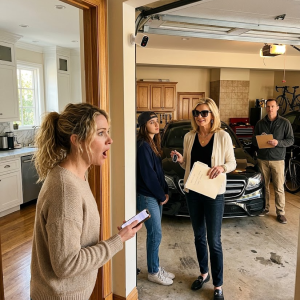
We went back the following afternoon with Marcus, a county deputy, and a locksmith who looked as if he’d seen every human mess possible and preferred not to comment on any of them.
Snowmelt dripped from the gutters.
My stomach churned so hard I thought I might be sick on the front walk.
Ryan opened the door before I could use my key.
He was wearing the gray cashmere sweater I had bought him three Christmases earlier.
For half a second he looked smug, almost amused, as if he expected me to apologize.
Then he saw Marcus, saw the deputy,