love.
Love that thrives on your dependence is not love.
I didn’t say any of that out loud.
I just stepped aside and let him walk out of the house he had tried to use as leverage against me.
The legal fallout lasted three months.
Ryan’s attempted refinance triggered a fraud review.
His company quietly placed him on leave once the relationship with Tessa, a direct report on a sensitive project, came to light.
Through his attorney he offered settlement after settlement, each one more panicked than the last.
Marcus advised patience.
In the end Ryan signed an uncontested divorce, waived any claim to the residence, returned the traceable funds remaining in the LLC account, and accepted language that kept the trust from pursuing a broader civil claim so long as he ceased contact.
It was the closest thing to mercy I was interested in.
The strangest part was what came after.
Not triumph.
Not the movie version where you stand in the center of a reclaimed house and feel instant power rush back into your bones.
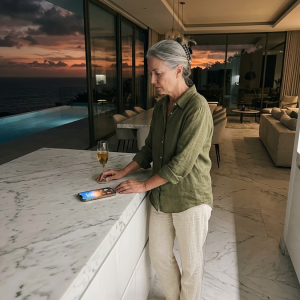
The first night alone there, I sat on the living room floor eating crackers out of the box because I couldn’t face a real meal.
Every room held two ghosts: the life I thought I had, and the version of me who had tolerated it.
I wandered through the kitchen and saw the faint ring where Tessa’s coffee mug had sat.
I scrubbed that counter until my hands hurt.
A week later Helena delivered one final item my father had left for me: a recorded message.
In it he sat at his workbench, glasses slipping down his nose, looking tired and stubborn and unmistakably himself.
“If you’ve used the card,” he said, “then something in your life has broken.
I’m sorry I couldn’t spare you that.
Money won’t keep your heart from breaking, Em.
But it can buy you time, privacy, and the freedom not to stay where you’re being diminished.
Use that freedom well.” I watched it three times.
The third time I laughed through tears when he added, “And for once in your life, read the paperwork.”
I did more than that.
I read everything.
The trust documents.
The old closing papers.
My own bank statements.
The story of how I had slowly handed over decision after decision because it felt easier to call it peace.
Halcyon set up financial advisors and therapists and offered me enough support that I could have disappeared into comfortable recovery if I wanted.
Instead, once the worst of the chaos passed, I went back to work.
Not because I had to.
Because I needed my own momentum again.
I consulted first, then took a strategy role with a regional design firm that cared more about ideas than polished resumes.
On weekends I dug up the dead plants by the back fence and replanted my mother’s garden from scratch.
Ryan sent one last email six months later.
It had no subject line.
Just a single sentence: I never thought you’d actually leave.
I stared at it for a long time because hidden inside it was the entire marriage.
He never thought I’d leave because he had spent years building a life where leaving felt impossible.
He never imagined that the quietest person in the room might