She wore a pink T-shirt that had gone gray with dust, one white sock, and a look on her face I had seen in too many interview rooms to ever mistake: the look of a child trying to decide whether a new adult is safer than the one she already fears.
A stuffed rabbit was pinned under her arm.
Beside her were two juice boxes, a stack of crackers, a flashlight, a plastic bucket lined with a grocery bag, and a battery-powered night-light clipped to the shelf above her head.
None of that belonged to a game.
When the light touched her, she flinched hard enough to make my own ribs ache.
Her eyes flew to my face, then past me, then back again.
“Please,” she whispered.
Her voice was raw from crying.
“Please don’t tell Dennis.”
I knelt so fast my knee cracked against the wood.
“I’m not going to let anyone hurt you,” I said, keeping my voice low and slow.
“My name is Stanley.
What’s yours?”
She hesitated, as if names were dangerous too.
“Livie.”
“Okay, Livie.
You’re safe right now.” I held my hands where she could see them.
“Can you come out here for me?”
Her fingers tightened around the rabbit.
“Is he mad?”
The question landed like a blow.
“No,” I said, and hated the lie even as I used it to get her moving.
“He’s not here.”
Rosa appeared at the top of the ladder behind me and made a sound I had only ever heard from professionals when the job gets personal.
Livie crawled out inch by inch, stiff and careful, like movement itself might get her in trouble.
When she stood, I saw how cramped she had been; her legs trembled so badly I caught her before she tipped.
The outside of the closet door had scrape marks near the latch.
Fresh ones.
We took her downstairs and sat her at the kitchen island because it was the nearest bright, open place in the house.
Rosa wrapped a throw blanket around her shoulders.
I poured water into a glass, then changed my mind and found a plastic cup instead.
Children don’t need elegance when they’re scared.
They need something that won’t break if their hands do.
Livie drank like she had been told to sip carefully and suddenly wasn’t sure the rule still applied.
Her shoulders stayed lifted all the way to her ears.
Every few seconds she glanced toward the ceiling, then toward the front door.
“How long were you up there?” I asked.
She licked cracked lips.
“Since morning.”
“Did someone put you there?”
A tiny nod.
“Who?”
Her eyes filled again.
“Dennis said it was an attic day.”
Rosa turned away and pressed both hands to her mouth.
I took out my phone and dialed 911.
Then I called the state child abuse hotline, because old habits survive retirement and because I knew exactly how fast stories get cleaned up when you leave room for ambiguity.
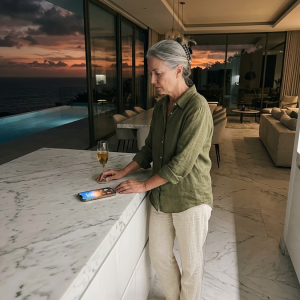
When the dispatcher asked what I had found, I looked at the spotless countertops, the bowl of fake fruit, the white cabinets glowing under designer lighting, and said the words as clearly as I could.
“A child was hidden in the attic of my son’s home.”
Livie started to shake when I