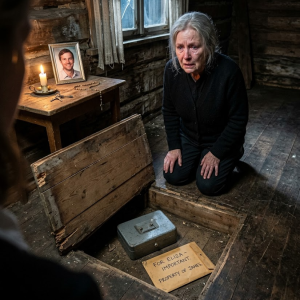
at the center whether she was allowed to sleep stretched out.
Emergency kinship placement went through three days later after a home check and a stack of signatures that made my old wrist ache.
I brought her to my apartment because there was nowhere else I trusted.
The dresser I had been sanding when Rosa called became hers after all.
I finished it in the evenings while she sat at the table coloring, giving the wood the same care I wished I had given my son’s life before he learned to sand his own conscience smooth.
Rosa came over with curtains covered in tiny yellow stars.
My neighbor from 4B donated a lamp shaped like a moon.
Livie chose the rabbit and the gas-station dog to sit together on the pillow as if she had decided nobody in that room would ever be hidden from anybody else again.
The first night she slept at my place, I showed her the bedroom and the little closet by the window where I kept winter coats.
She stared at the closet for a long time.
Then she asked, very quietly, “Do you want me in there when people visit?”
I had testified in family court.
I had sat with children after removals and after reunifications and after funerals.
Nothing in thirty-eight years prepared me for that sentence.
“No,” I said.
My voice broke anyway.
“In this house, doors are for keeping coats in and weather out.
That’s all.”
She studied my face as if checking whether adults were allowed to change the rules so completely.
Then she nodded once and walked past the closet into the middle of the room.
That tiny act felt bigger than the arrest.
Dennis called twice from jail before I blocked the number.
The first time he wanted money.
The second time he wanted me to tell the prosecutor Livie had special needs and I was exaggerating.
He kept saying, “You don’t understand how hard she was,” as if difficulty were a defense.
I understood plenty.
I understood exhaustion.
I understood grief arriving in a child-sized body after Kara’s death and detonating inside a marriage built around convenience.
I even understood resentment.
What I do not understand, and never will, is how a father hears his daughter crying through wood and decides the better answer is thicker insulation.
Livie is with me now while the court works through the rest.
She has started first grade again at a school two blocks away.
She still lowers her voice when she hears delivery trucks in the hall.
She still asks before opening the refrigerator.
But last week Rosa dropped by unannounced, and Livie didn’t run to hide.
She ran to the door.
People ask whether turning in my own son felt like betrayal.
They ask it carefully, with their heads tilted, as if family blood changes the shape of right and wrong.
Maybe to some people it does.
All I know is this: the first morning after Livie moved in, I woke up before sunrise and found her asleep sideways across the bed, one arm flung over the moon lamp, both closet doors open wide because she had spent the night making sure they stayed empty.
And in that pale light, with no one shushing her and no ceiling above