before.
Not fear.
Not shame.
Annoyance.
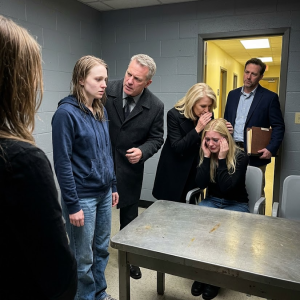
“Come here,” he said to her.
She pressed herself against my side so fast the chair legs scraped.
Detective Holloway held up a hand.
“You don’t give instructions in this room.”
Dennis dragged a palm over his mouth.
“You’re making this look insane.
She wasn’t locked up.
That was a safe space.
She gets overwhelmed.
She wanders.
We were waiting for a sitter.”
Trisha started crying again.
“We were trying to manage a really complicated situation.
Kara dumped all this on us and then died.
We had no help.
No warning.
My contracts were already signed.
I couldn’t just put a child online.”
I looked at her and thought about the filtered breakfasts, the beach reels, the captions about balance.
“Then don’t put her online,” I said.
“You don’t build a closet.”
Dennis’s eyes snapped to mine.
“You don’t get to judge me.
You spent your whole life saving strangers and left me to raise myself half the time.”
It was a cruel line, which is how I knew it had been polished.
Maybe he had been carrying it for years.
Maybe it was even partly true.
Social work is full of borrowed emergencies, and my son had grown up alongside too many of them.
I had missed dinners.
Missed games.
Missed subtler wounds than the ones I was trained to spot.
But guilt and permission are not the same thing.
“Maybe I failed you,” I said.
“That still doesn’t give you the right to do this to her.”
Detective Holloway placed photographs on the table one by one.
The latch.
The bucket.
The foam panels.
The calendar marks.
The worksheet with her last name.
Then a screenshot from Trisha’s assistant, recovered from a text thread on the kitchen iPad they had forgotten to lock.
April: I can’t come tomorrow.
My son’s fever is back.
Trisha: Then just don’t answer anyone if Stanley’s cleaner goes.
Dennis: Livie can stay upstairs till evening.
She knows the rule.
Trisha made a sound like a glass cracking.
“I said evening,” Dennis snapped, as if the distinction mattered.
Holloway slid one more photo forward: the close-up of scrape marks on the inside of the closet door where Livie had been trying, at some point, to get out.
No one spoke after that.
The state moved fast, faster than I had ever seen when I was still working.
Maybe because the evidence was so clean.
Maybe because child endangerment looks especially ugly against white walls and sponsored skincare.
By that afternoon, both of them were under investigation for neglect and unlawful restraint.
By the next week, formal charges were filed.
Trisha’s lawyer tried to frame her as a panicked stepmother trapped inside Dennis’s decisions.
Maybe there was some truth in that.
She hadn’t installed the latch; the hardware receipt was in Dennis’s email.
But she had stepped over the same attic cord every day and posted morning affirmations beneath it.
Complicity has a softer face than cruelty.
It is still its cousin.
The hardest part was Livie.
Not the paperwork.
Not the interviews.
Her.
The way she apologized for needing the bathroom.
The way she froze before taking food from a plate, as if permission might expire between reaching and touching.
The way she asked on the second night