was a job.
I arrived at two, left at five, and did what needed doing.
I prepared tea.
I read the newspaper aloud because his eyesight tired quickly.
I checked the pill organizer and reminded him which tablets came before dinner.
I opened stubborn jars, watered plants, folded blankets, and wiped dust from shelves.
He was not gentle in the way people expect old men to be.
He corrected me when I misread foreign names.
He argued with opinion columns as if the writers could hear him.
He refused to let me call him poor thing, even once, though I had not meant anything by it.
“Pity is a lazy kind of cruelty,” he said.
“Do not bring it into my house.”
I should have disliked him.
Instead, I found myself looking forward to the sound of his cane in the hallway.
Ernesto listened in a way that made lying difficult.
When he asked whether I had slept, he watched the answer before I spoke.
When he asked whether my husband was kind, I dropped a spoon into the sink and said, “He works hard.”
Ernesto only nodded.
“That was not my question,” he said.
I hated him a little for that.
Then I respected him for it.
Weeks passed.
The house became familiar.
I learned which floorboards creaked and which windows stuck.
I learned that Ernesto liked the afternoon sun in the sitting room but hated overhead lights.
I learned he kept a scarf of his wife’s folded in the top drawer of the hallway cabinet and sometimes opened the drawer only to touch the fabric with two fingers.
Her name had been Clara.
He spoke of her carefully, not often, but when he did, the room changed.
Clara had been a schoolteacher.
She had danced in the kitchen.
She had painted birds badly and refused to apologize for it.
She had once thrown an entire roast out the back door because a guest insulted a stray dog.
“She believed kindness without courage was only manners,” he told me.
One rainy Thursday, I found him in the study staring at a photograph of her.
“She was beautiful,” I said.
“Yes,” he replied.
“But beauty was the least dangerous thing about her.”
I smiled.
He did not.
“You remind me of someone,” he said.
I had heard that before from strangers in grocery stores and old women at church.
Usually it meant nothing.
Everyone reminds someone of someone.
But Ernesto said it with such heaviness that I felt the air shift.
“Your wife?” I asked.
He shook his head slowly.
“No.”
I waited.
He closed the photograph album.
“Not her.”
After that, he became quieter for several days.
At home, my own silence grew louder.
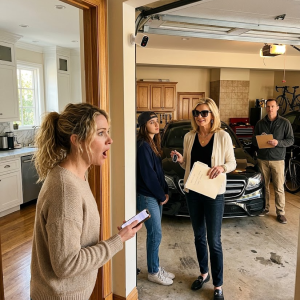
Mark had started taking phone calls in the garage.
When I entered a room, his screen turned dark.
He said work was stressful.
He said I was imagining things.
He said I had become sensitive.
That word made me feel foolish, which I suppose was the point.
One night, after dinner, I told him Ernesto had asked me to stay an extra hour on Fridays and would pay more.
Mark looked up then, suddenly interested.
“Good.
We could use it.”
Not, Are you tired?
Not, Is it too much?
Just good.
Our daughter, Emily, asked