his hands.
His shoulders were curved inward, not from age this time, but from shame.
“Ernesto,” I breathed.
“Are you all right?”
He startled and moved to close the box.
Too late.
I saw the photograph.
A young woman stood in a summer dress beside a fountain, one hand lifted to shield her eyes from the sun.
Her hair was dark and loose around her shoulders.
Her smile was quiet, almost reluctant.
The room seemed to tilt.
Because she looked like me.
Not exactly.
The face was younger than mine, softer in some places, sharper in others.
But the eyes, the angle of the mouth, the small crease near one cheek when she smiled—those belonged to my mirror.
“Who is that?” I asked.
Ernesto closed his eyes.
Outside, thunder rolled over the roof.
“Her name was Isabel,” he said.
The name moved through me like cold water.
My mother’s middle name had been Isabel.
I had never known my mother well.
She died when I was eight, and my father spoke of her as if memory itself were dangerous.
When I asked questions, he offered thin answers.
She was kind.
She liked music.
She had family far away.
After he died, there were few photographs, fewer stories, and no one left to ask.
“Why do you have that?” I said.
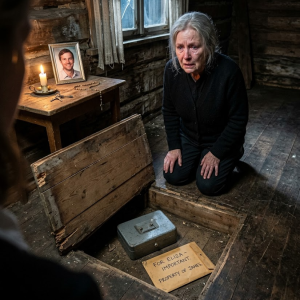
Ernesto’s hand trembled on the edge of the leather box.
“Because I was a coward,” he said.
The rain began then, hard against the windows.
I stepped closer despite myself.
Inside the box were letters tied with faded ribbon, a small gold locket, and several more photographs.
In one, Isabel stood beside Ernesto, much younger, his arm not around her but near her, as if he had wanted to touch her and had stopped himself.
“Tell me,” I said.
He looked suddenly ancient.
“Sit down, Laura.”
“No.”
The word came out sharper than I intended.
I was tired of men asking me to soften myself before receiving the truth.
Ernesto accepted it with a nod.
“Before Clara,” he said, “there was your mother.”
I gripped the back of a chair.
He told me slowly, each sentence dragged from a place he had locked away for decades.
Isabel had worked as a translator for an engineering firm when Ernesto was in his early thirties.
They met in Madrid.
She was brilliant, stubborn, and engaged to another man back home, a man chosen more by family pressure than love.
Ernesto was already promised to Clara, though the arrangement was not yet formal.
They should have stayed strangers.
They did not.
For six months, they wrote letters, walked through foreign cities, and spoke of impossible futures.
Then Isabel disappeared from his life after one final letter.
“She told me she was pregnant,” Ernesto said.
The room went silent except for the rain.
I could hear my own heartbeat.
“No,” I whispered.
He flinched as if I had struck him.
“She begged me to answer.
She said she would leave everything if I asked her to.
She said she could not raise a child inside a lie.”
“And did you?” My voice shook.
“Did you answer?”
He looked at the photograph.
“I wrote the letter.
I told her I loved her.
I told her to come to me.
I told her I would face