the trustees and today’s notice to the property manager, possession can be turned over immediately.
Court confirmation will follow.”
“Then do it.”
The sound of tires on gravel came before the knock.
Another car door slammed.
Then another.
Walter glanced through the front window and said, “They are here.”
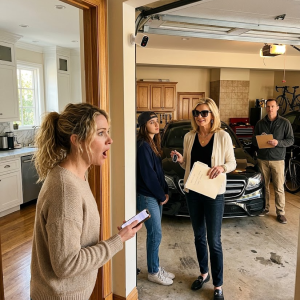
My parents stepped onto the porch five seconds later.
My mother came in first, still carrying the expression she used when she expected to manage a situation by tone alone.
My father followed, already irritated, already defensive.
I could see from the confusion on their faces that they had expected a listing appointment or a routine meeting.
Then they saw me.
My mother’s mouth actually fell open.
“Sarah?”
My father swore under his breath.
“What is this?”
Evelyn did not raise her voice.
She never had to.
“A reckoning,” she said.
“Sit down.”
Neither of them sat.
My mother recovered first, which was typical.
“I do not understand why she is here,” she said, turning to Walter as if I were a clerical error.
“This is trust business.”
“It became Sarah’s business three years ago,” Evelyn said, “when I created the trust for her benefit.
A fact you somehow forgot to mention while she and my great-granddaughter were sleeping in a shelter.”
The word shelter changed their faces.
Not to horror.
Not immediately.
First came calculation.
That was the part I will never unsee.
My father looked at me.
“You were at a shelter?”
“Do not,” I said.
“Do not act surprised.”
My mother lifted her chin.
“We knew you were having financial trouble.
We did not know it had come to that.”
I laughed, and it sounded ugly even to me.
“I called you crying.”
“You call crying every time life gets hard,” she snapped, and then seemed to realize too late that she had said the quiet part out loud.
The room went still.
Evelyn slid the forged document across the dining table.
“Explain this.”
My mother did not touch it.
My father glanced down, then away.
That tiny glance was enough.
Walter placed the rental records beside it.
“And these.”
My father blew out a breath through his nose.
“We can explain.”
“You can try,” Evelyn said.
What followed was one of the ugliest performances I have ever witnessed.
First they denied.
Then they minimized.
Then they reframed.
The signature was a paperwork misunderstanding.
The rental income had gone toward maintenance.
The house had needed to stay productive.
They had not wanted the asset sitting empty.
They believed I would not accept charity anyway.
They assumed I would land on my feet.
“You assumed wrong,” I said.
My mother turned on me like my pain was an inconvenience.
“You have always been impulsive, Sarah.
You quit jobs.
You make emotional decisions.
We were trying to preserve something stable instead of handing you a house the first time you struggled.”
“The first time?” I stepped closer before I even realized I had moved.
“Lia and I slept in a room with fourteen strangers.”
My father rubbed his forehead.
“We were under pressure too.
The business was failing.
We were behind on our own mortgage.
We used the rent temporarily.
Temporarily became longer than we expected.
We were going to put it back.”
“By selling the house?” Walter asked evenly.