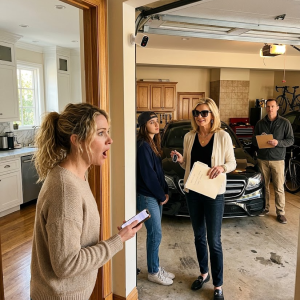
once more with me, slower this time, pointing out practical things as if reassembling the world through logistics might keep me upright.
The breaker box.
The pantry shelves.
The linen closet.
The small leak stain near the laundry room that had already been scheduled for repair.
Then she handed me a set of new keys.
“Bring Lia home,” she said.
I cried then.
Hard.
The kind of crying that starts somewhere below language.
Evelyn put one hand between my shoulder blades and left it there.
We had lost two years to distance, some of it my fault, some of it not, and neither of us was sentimental enough to pretend one afternoon erased that.
But standing in that kitchen with keys in my hand, I understood something clearly: she had shown up.
Whatever came next, she had shown up.
When I brought Lia through the front door that evening, she stopped so abruptly I nearly walked into her.
She looked around at the empty living room, the sunlight fading gold along the floor, the back hallway, the little yellow bedroom, and then up at me.
“Are we visiting?” she whispered.
I knelt in front of her.
“No, baby.
We live here now.”
She stared at me for another heartbeat, then launched herself at my neck so hard I rocked backward.
“Really?”
“Really.”
She ran room to room in her socks, choosing where her bed should go, where her crayons should live, which window was hers.
At one point she stood in the doorway of the yellow room and asked, with complete seriousness, “Can I keep my shoes under this bed too?”
That question nearly undid me all over again.
Because that was what safety meant to a child who had been trying so hard to be easy: not luxury, not explanations, just the right to put her shoes down somewhere and assume they would still be there in the morning.
We slept on air mattresses that first week.
Evelyn sent over groceries, towels, lamps, and a woman named Marisol who had organized half of Evelyn’s life for twenty years and, apparently, knew how to organize a house into livability in six hours.
Walter filed the emergency petition the same afternoon.
By the end of the week, a judge ratified my parents’ removal as trustees and ordered a full accounting of the trust funds.
The attempted sale was dead.
The house was mine to occupy, exactly as it should have been from the start.
There were consequences beyond that.
My parents’ attorney pushed for settlement the minute the forged document and transfer trail became impossible to explain away.
Restitution was arranged.
Their access to every trust-related account ended.
Walter told me criminal referral remained possible, though Evelyn let the civil remedies move first.
She said something I will not forget: “Justice and revenge are cousins, not twins.
Know which one you are feeding.”
I did not reconcile with my parents.
Not then.
Maybe not ever.
My mother left long voicemails at first, crying, apologizing, circling back to excuses about fear, pressure, and how families sometimes make terrible decisions when money is involved.
My father sent shorter messages, mostly practical ones, asking whether there was a way to keep this private.
I deleted both kinds for weeks without answering.
One night, about