the store.
“Call Dr.
Bell.
Tell him to meet us here.
Bring blankets from the car.
And food.
Everything hot they have left in that store.”
Luca nodded and moved immediately.
Rocco crouched in front of Lena, careful to keep his hands where she could see them.
Up close, he could see how long hunger had been working on her.
Her lips were dry.
There were gray half-moons beneath her eyes.
Pride still held her spine together, but not by much.
“I’m not here to collect,” he said.
“I want names.”
Lena stared at him as if the sentence itself made no sense.
Emma sat beside her mother and took her hand.
That seemed to unlock something.
Lena’s face crumpled, and the tears came silently at first, then with short, painful breaths she kept trying to swallow back.
Shame had exhausted her almost as much as hunger.
Once Luca returned with soup, bread, bottled water, and medicine for the baby, the story came out in broken pieces.
Lena’s husband, Owen Turner, had worked dispatch for a trucking subcontractor tied to one of Rocco’s legitimate warehouse operations on the riverfront.
Six months earlier, there had been a fire in a loading bay.
Owen had helped get people out.
He died of smoke inhalation before dawn.
After the funeral, Lena received a small death benefit and the first insurance payment.
Two weeks later, three men knocked on her door and said Owen had owed money tied to a cargo loss.
She told them there had to be a mistake.
Owen did not gamble, did not drink, did not borrow.
The tallest man smiled and said debt did not stop being debt because a widow found it inconvenient.
She paid what she could to make them leave.
They came back anyway.
Each visit got crueler.
They took the television.
Then the table and chairs.
Then the children’s clothes that still had tags on them from church donations.
The last time, when Lena could barely stand, they took Noah’s crib and laughed because the baby started crying while they carried it out.
Emma tried to stop them.
One of the men grabbed her arm hard enough to leave bruises.
Rocco’s jaw tightened so hard it ached.
“Did you recognize any of them?” he asked.
Lena nodded.
“One.
Dino Ferrara.
I saw him once at a benefit dinner your people sponsored after the flood last year.
He wore the same saint medallion then.
He wore it here too.
He told the others they were covered because this was Moretti business.”
That alone was enough to turn anger into something colder.
Then Lena pointed weakly toward the far wall.
“They searched for something before they left,” she said.
“My husband hid papers under a loose floorboard the week before the fire.
He told me if anyone came asking questions, I was to keep them hidden.
I never looked.
I was afraid of what I’d find.”
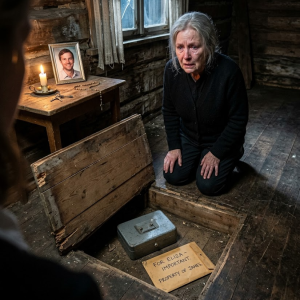
Rocco crossed the room, crouched, and pried up the loose board with his fingers.
Inside was a torn collection slip folded around a wedding photo, a utility bill, and a small black notebook no bigger than his hand.
The slip listed seized property in neat columns: couch, table, winter coats, crib, microwave, cash envelope.
At the bottom were initials written in