property already has a bridge loan hanging off it like an anchor.”
Sydney leaned forward.
“He was our father.”
“And he was my husband,” I said.
“I bathed him.
I fed him.
I held him when he was afraid.
You don’t get to say the word father as if blood is the highest form of loyalty in the room.”
Edwin started crying quietly then, more from panic than remorse.
It would have moved me more if I had not watched Floyd wait by the phone so many times for a call that came too late or not at all.
I told them I would authorize the release of Floyd’s personal effects with sentimental value—his watch collection, the naval photos from his father, the letters from their mother, the oak desk from his study if they wanted it.
But I would not use the money Floyd secured for me to rescue them from the consequences of treating a dying man like a portfolio.
That was the last conversation we ever had as anything resembling family.
The unraveling happened quickly after that.
The lender on Tahoe refused another extension.
Westmere’s minority partner enforced the buyout clause.
The warehouse fines escalated.
One commercial parcel sold under pressure for less than it should have, which triggered another ugly chain of numbers.
By the time the Sacramento house and Tahoe villa were both sold to satisfy liens and obligations, there was almost nothing left.
Sydney blamed everyone—Heller, the market, Floyd, me, Edwin, timing.
Edwin disappeared into the kind of shame that looks from a distance like passivity but is really a refusal to stand up under the weight of what you have done.
I heard through David Chen that the brothers ended with a fraction of what they once thought was waiting for them.
Enough to survive.
Not enough to feel victorious.
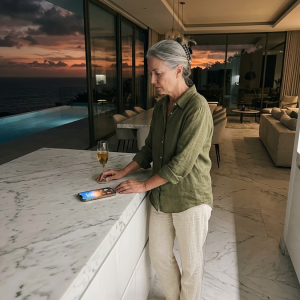
As for me, I moved into a smaller house on the coast that Floyd had placed into the marital trust months before he died.
It was not grand, and that was part of its mercy.
No echoing hallways.
No staff.
No rooms heavy with other people’s entitlement.
Just a bright kitchen, a study for my drawing table, and a narrow garden where I planted cuttings from the old roses.
I reopened my design practice the following spring.
Not because I needed to, exactly, but because I had forgotten what it felt like to make something that belonged entirely to me.
The first time a client asked my opinion and waited for the answer as if it mattered, I almost cried in the car afterward.
Sometimes people still ask whether Floyd was too harsh.
Whether I should have stepped in once the lesson became clear.
Whether grief can make people say and do things they would never otherwise choose.
Maybe it can.
But there is a line between grief and greed, and Sydney crossed it while the funeral flowers were still alive on my kitchen counter.
Edwin crossed it when he opened drawers in my home as if I were already gone.
Floyd did not leave them poor.
He left them responsible.
The fact that they experienced responsibility as punishment says more than any courtroom ever could.
On certain cold mornings, I stand in my new garden with coffee in both hands and think