forcing her into humiliation and I had the power to ease it.
There is a kind of guilt that settles into a daughter so slowly she mistakes it for love.
When she answered my call from the hospital, she sounded almost cheerful.
“Hi, honey! I’m packing.”
I remember how carefully I chose my words because I still believed there was some version of her that would hear the fear in my voice and become a mother.
“Mom, I’m in the hospital,” I said.
“I was in an accident.
I need you to take Owen tonight.
Jacob’s stuck in Denver.
I can’t even stand up.”
There was a pause, then her sigh.
That sigh.
The one that carried the full weight of her disappointment before she had even decided what to say.
“Melissa, I can’t.
I have plans.”
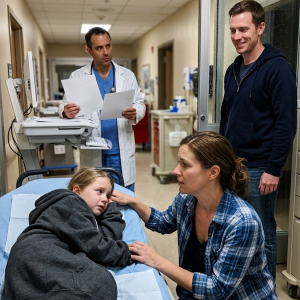
I looked toward the open doorway.
A nurse was trying to calm Owen in the infant carrier.
He had worked himself into those breathless little cries babies get when they can’t understand why the person they want is near but not coming.
“Mom,” I whispered, because I was already close to crying and hated that she could hear it.
“He’s six weeks old.
I just need tonight.”
She didn’t soften.
“Your sister never has emergencies like this,” she said.
“Lauren handles her responsibilities.
You always have chaos.”
Even on a hospital bed, with my pelvis fractured and my son crying ten feet away, she found a way to compare me to Lauren.
Lauren, the older daughter who had somehow stayed golden no matter what.
Lauren, whose mistakes were called seasons, while mine were called patterns.
Lauren, who lived forty-five minutes away and had two kids and a husband and a life I never resented until my mother started using her as a weapon.
“Please,” I said.
“Jacob will be here tomorrow morning.”
“I’m leaving for a Caribbean cruise this afternoon,” she said.
“I deserve this vacation.
Call somebody else.
And don’t try to make me feel guilty.”
Then she hung up.
I didn’t cry.
That part surprises people when I tell this story.
They expect some dramatic collapse.
They expect anger first.
What I felt was colder than anger.
I felt clarity.
I booked an overnight postpartum nurse from my hospital bed.
Then a daytime caregiver for the next two days until Jacob could get home and we could figure out a safer plan.
The rates were obscene, but there are moments in life when the number does not matter because the alternative is impossible.
Then I opened my banking app.
The monthly transfer to my mother was pending.
SUSAN – SUPPORT.
I canceled it.
I didn’t stare.
I didn’t debate.
I didn’t hear my father’s voice telling me to be generous.
I just canceled it and set the phone down on my blanket.
A few hours later, my grandfather walked into my room.
Thomas Parker was eighty-one, broad-shouldered even now, the kind of man whose silence always meant more than other people’s speeches.
He had driven himself in after the hospital reached him as Jacob’s secondary contact.
I expected worry.
I expected questions.
Instead, he shut the door, looked at Owen asleep in the bassinet, looked at me, and said, “Tell me you stopped paying your mother.”
I blinked at him.
“What?”