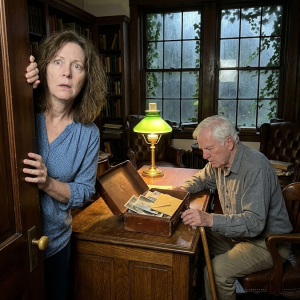
spoke then, voice flat.
“Family also answers the phone when their daughter is lying in a hospital bed and their grandson needs a place to sleep.”
That hit harder than anything I said, because she visibly bristled.
“I couldn’t just cancel a cruise at the last minute,” she snapped.
“Do you know how much that trip cost?”
My grandfather let out one humorless laugh.
“No, Susan,” he said.
“But your daughter probably does.”
The room went silent.
Then the front door opened and Lauren walked in.
I hadn’t invited her.
My mother must have, maybe for backup, maybe for sympathy.
She came in smiling at first, then took one look at the table and stopped.
“What’s going on?”
My mother started quickly.
“Your sister is being dramatic and—”
“Dad paid off the house before he died,” I said, cutting across her.
“Mom took money from me for nine years telling me it was for the mortgage.”
Lauren’s face drained.
“What?”
“That’s not how it was,” my mother said.
But Lauren had already picked up one of the screenshots.
I watched realization move through her in ugly little stages.
“Mom,” she said slowly, “you told me Melissa just wanted to help because she made more.”
Susan said nothing.
Lauren looked at the payoff letter next.
Then at me.
Then at our grandfather.
When she spoke again, her voice was smaller.
“The money you gave me for the townhouse down payment…”
My stomach dropped.
She closed her eyes.
That was my answer.
Not all of it.
But enough.
Enough to understand that my support had not just kept my mother comfortable.
It had reached into other parts of the family while I was being told there was barely enough to survive.
The attorney joined by speakerphone fifteen minutes later.
She explained Susan’s options in clean, unemotional terms.
We had documentation of repeated false statements connected to specific transfers.
We had a witness who knew the house had been paid off.
We had enough to make litigation expensive, public, and unpleasant.
Or we could settle.
Susan cried then.
Real tears, finally.
Not because of the accident.
Not because of Owen.
Not because I had spent one night in a hospital bed thinking I might have to choose between pain and my baby.
She cried because consequences had entered the room.
The settlement took three months.
She sold the house.
She liquidated an investment account I hadn’t known existed.
Lauren, to her credit, returned every dollar she could trace to what our mother had given her, then took out a small loan to cover the rest.
I did not recover all $486,000.
A lot of it was gone, burned through in trips and upgrades and years of a lifestyle funded by my guilt.
But I got back enough to pay off our own mortgage by a giant, satisfying chunk, finish my physical therapy without checking insurance every week, and put a real college fund in Owen’s name.
What I never got back was the version of my mother I had invented to survive loving her.
We have not spoken in eleven months.
She sent one letter around Christmas.
No money enclosed, no documents, no repayment update.
Just six pages about grief and loneliness and how losing my father had made her feel invisible, terrified,