To manage.
“Ethan, listen to me before you destroy this family over misunderstanding.”
I almost admired the efficiency of it.
Not what happened.
Not Nate.
Not hands.
The family.
“Mom,” I said, “you watched him bleed.”
Her breath caught.
Then she did what she had done my whole life when confronted with truth: she softened her voice and tried to make morality sound hysterical.
“He was troubled after Lydia died.”
Lydia.
My sister.
Nate’s mother.
Dead at thirty-eight from an aneurysm so sudden the world still felt rearranged by it.
“He needed firm guidance.”
“He needed grief counseling.”
“He was becoming dishonest.”
“He was fifteen.”
She changed tactics.
“You don’t understand what it was like in that house. Your father was under stress.”
I laughed then, a sound so sharp even I didn’t recognize it.
“You’re right,” I said. “I don’t understand what it was like in that house.”
That was the truest thing I said all week.
Because I had grown up there too, and I had known my father’s temper, my mother’s loyalty to order, the way love in our family always came braided with correction. But I had not understood what their house had become after my sister died. Grief had not softened them. It had stripped away restraint.
And Nate had been what remained.
The hearing was held three days later.
My parents came dressed for church.
That detail still makes me sick.
My father in a navy suit and polished shoes. My mother in a pale blue blouse with a small gold cross at her throat. They looked like people ready to host a prayer breakfast, not explain why a fifteen-year-old boy had words carved into his hands.
My father’s attorney tried the obvious strategy first. Grief. Misinterpretation. Self-harm. Troubled teen. Unreliable statements. Family tension. Overzealous uncle.
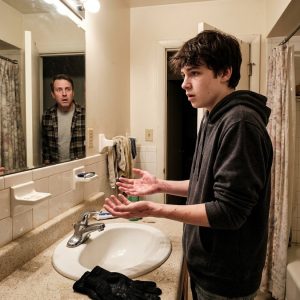
Then Nate took off the gloves in court.
He did it himself.
No prompting.
No drama.
He just slid them off and laid both hands flat on the table in front of the judge.
The room changed.
Not because anyone suddenly learned cruelty existed.
Because it was now impossible to translate what had happened into anything cleaner.
The judge, an older woman with a voice like iron wrapped in velvet, asked Nate only a few questions. Who wrote the first words. Who cut over them. Who watched. Who told him to hide it.
He answered all of them.
When asked whether he wanted to return to his grandparents’ home, he said, “I would rather sleep outside.”
That line ended whatever performance my parents had planned.
The judge granted temporary guardianship to Lila and me that same morning, ordered trauma therapy immediately, and expanded the investigation to include medical neglect, coercive abuse, and witness intimidation because, as it turned out, my father had already called two relatives pressuring them to “correct Nate’s lies before court.”
Rachel received her own call from investigators soon after.
Under questioning, her certainty evaporated. She admitted she had seen the marker words. Admitted she suspected cutting had happened later. Admitted my mother told her Nate “needed to carry the truth where he could see it.” She did not think it was serious enough to report, she said.
That sentence followed her into every room afterward.
Not serious enough to report.
What are hands for, then, if not to be taken seriously when they are destroyed?