He admitted “poor judgment under bereavement.”
He did not admit cruelty because men like him rarely can. Cruelty, in their minds, is always what weaker men do. What they do is order.
The judge did not indulge that distinction.
He sentenced my father to prison time, mandatory psychiatric evaluation, and a lifetime bar from caregiving custody of any minor.
My mother received probation, supervised counseling, and a permanent no-contact order with Nate unless he petitioned for it himself as an adult.
He has never petitioned.
Rachel sent one long letter about broken families and misunderstood intentions. Nate read the first paragraph, handed it back to me, and said, “Can we just be done?”
So we were.
The following summer, almost exactly a year after Nate arrived with one backpack, one duffel bag, and those gloves, he walked into the kitchen wearing a T-shirt, no gloves, and an expression I didn’t recognize at first because I had never seen it settle on him.
Ease.
He reached into the fruit bowl, picked up a peach with his bare hand, and bit into it standing right there in the morning light.
Juice ran over one palm and down his wrist.
He looked at it.
Paused.
Then licked it off and kept eating.
I had to turn away and pretend I was looking for coffee because I was not going to cry over a peach in front of a sixteen-year-old boy who had worked that hard to feel ordinary.
A month later, the guardianship became permanent.
Not temporary placement.
Not summer help.
Permanent.
Nate chose to keep his last name. That surprised some people. It didn’t surprise me.
“I’m not giving them my name too,” he said.
Fair enough.
We painted his room dark green that fall. He joined the school robotics team. Got taller. Argued with me about curfews. Learned how to grill burgers badly. Started leaving the house without checking whether his sleeves covered his forearms. The scars on his palms softened from angry ridges to pale lines. They will never disappear completely. Neither will what happened.
But scars are honest that way. They stop pretending they are wounds.
On the second anniversary of his coming to live with us, he asked if we could drive past my parents’ old house. Not stop. Just pass it.
So we did.
The curtains were different. The flower beds were messy. The front porch looked smaller than I remembered.
Nate stared out the window a long time.
Then he said, “I thought it would feel bigger.”
I nodded.
“Abusive places always do when you’re trapped in them,” I said.
He considered that. Then he leaned back and said, “I’m glad it looks normal now.”
That was when I knew he was really leaving it.
Not forgetting.
Not forgiving.
Leaving.
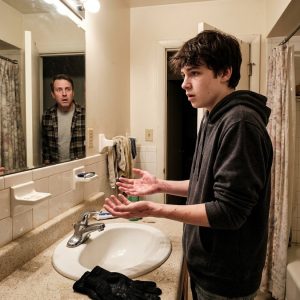
People think the worst moment of this story was opening the bathroom door and seeing those words carved into my nephew’s hands.
It wasn’t.
That was the moment truth arrived.
The worst part came before, when he believed those words belonged to him.
What changed everything was not outrage alone. It was what happened after.
We believed him.
We documented it.
We did not negotiate with family.
And we built him a life where his hands could mean ordinary things again.
A steering wheel.
A pencil.