the older she got, the more she understood that instincts needed records if they were ever going to protect somebody.
At 3:39 a.m., she pulled into the hospital parking structure, parked on level two, turned off the engine, and sat motionless for four seconds.
She used to do that before surgeries she knew would demand everything she had.
Stillness was command.
Then she got out and walked into the emergency department.
The doors opened with the same hushed mechanical sigh she remembered from years of night shifts.
Everything about an ER after midnight felt suspended: the bitter coffee, the fluorescent fatigue, the beep of machines measuring private crises, the tired child asleep across two waiting-room chairs while adults whispered nearby as if volume itself could injure someone.
Dorothy crossed the floor toward the nurse’s station.
James Whitaker looked up and went still.
He had trained with her decades ago.
He had once been the resident who could suture faster than anyone else in the program and still recite medication protocols from memory.
Age had silvered his temples and thickened the lines around his mouth, but he still carried himself like a man who knew how expensive mistakes could be.
“Dorothy,” he said softly, “tell me that child in Bay Four is not Brooke.”
The words landed like confirmation, not surprise.
“Tell me where she is,” Dorothy said, “and tell me what you’ve documented.”
James handed his tablet to a resident.
“Bay Four.
Closed radial fracture.
Temporary splint placed.
Imaging complete.”
“What mechanism was reported?”
“Fall down the stairs,” James said.
“Repeated by the stepfather.
Confirmed by the mother.”
“And your medical opinion?”
His jaw set.
“It’s not a staircase fracture.”
Dorothy didn’t blink.
“It’s forced hyperextension.
Someone either yanked the arm backward or twisted it while she resisted.
You know the pattern.”
“Yes,” Dorothy said.
“The stepfather is in the family waiting area.
Loud enough to establish himself, careful enough not to cross a line in front of witnesses.
The mother is physically beside him and emotionally a mile away.
I separated them from the bay.
I have a report drafted, not submitted.”
“Why not submitted?”
“Because if I filed before she had support in the building and they pushed for discharge under the mother’s consent, we could lose her.”
That answer told Dorothy everything she needed to know.
“File it now,” she said.
“Include fracture inconsistency.
Include patient affect.
Include every interruption by the stepfather.”
“Already in there.”
“If imaging suggests prior injury, I want another read.”
James gave the smallest nod.
“I was already ordering it.”
Patricia, the charge nurse, stepped closer.
She was compact, silver-haired at the nape, and had the expression of a woman who had spent years dealing with aggressive men without ever once being impressed by them.
“Social work is on the way,” Patricia said.
“Child protective services will be called once the physician submits.
Security is already aware there may be a problem.”
“Good,” Dorothy said.
Then she walked to Bay Four.
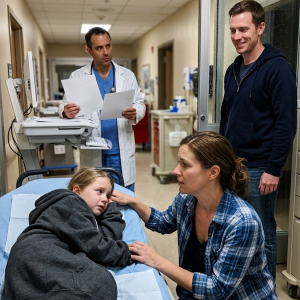
Brooke sat against the wall under a hospital blanket, left arm in a temporary splint, right knee pulled to her chest.
Her mascara had dried in faint shadows at the corners of her eyes.
Her hair had slipped loose.
She looked both younger and older than sixteen.
When she saw Dorothy,